Blogs
An overflow to the Venus flytrap page
Introduction
My Venus flytrap page has gotten a bit monolithic, so I created this one to show some other aspects of the plant, captured in photographs.
A good harvest
This pic shows how efficient one of the plants was at catching bugs.

Busy traps
On the upper left is a trap with the remains of a jumping spider. On the lower right, is a trap with the remains of a fly. The trap immediately to the left of the one with the fly is busy feeding.
(10 November 2025)
It almost got away
While at Sondela, the plant caught a fly which almost got away. The head was outside the cilia (cage hairs) of a trap, but it still failed to escape. On another occasion, I did try feeding a Christmas Beetle (Camenta innocua - thanks to James Harrison for the scientific name) to a plant. That beetle simply walked straight out of a trap which had closed on it.
On the occasion shown here, one of the plants caught a wasp-like insect which also almost got away...

A wasp half way out of a trap
As you can see from the pic, this insect was not happy. It had already bitten off several of the cage hairs and was actively attacking another.

Wings freed
In this pic, taken three hours after the previous one, you can see the insect had managed to free its wings. It was still extremely aggressive towards the trap it was caught in.
Amazingly, after almost 40 hours the insect was still alive. It wasn't fighting the trap anymore, but if I touched it, everything still moved.
Even more amazing, later in the day, the insect had actually escaped (unless a bird took it). There was no carcass under the plant, so it had gone. Whether the trap had begun releasing it, allowing it to fly off with a half-digested gut, we will never know.
In the pic below, you can see how the insect had damaged the trap.

Damaged trap
(11 November 2025)
A pretty trap
One of the plants in the B-pot has really pretty traps.

Pretty trap
(7 February 2026)
Too big
One of the plants caught a cockroach. It almost looks as though it had dived head first into the trap, so had no chance once the trap closed. Note the antenna curling out of the trap on the left!
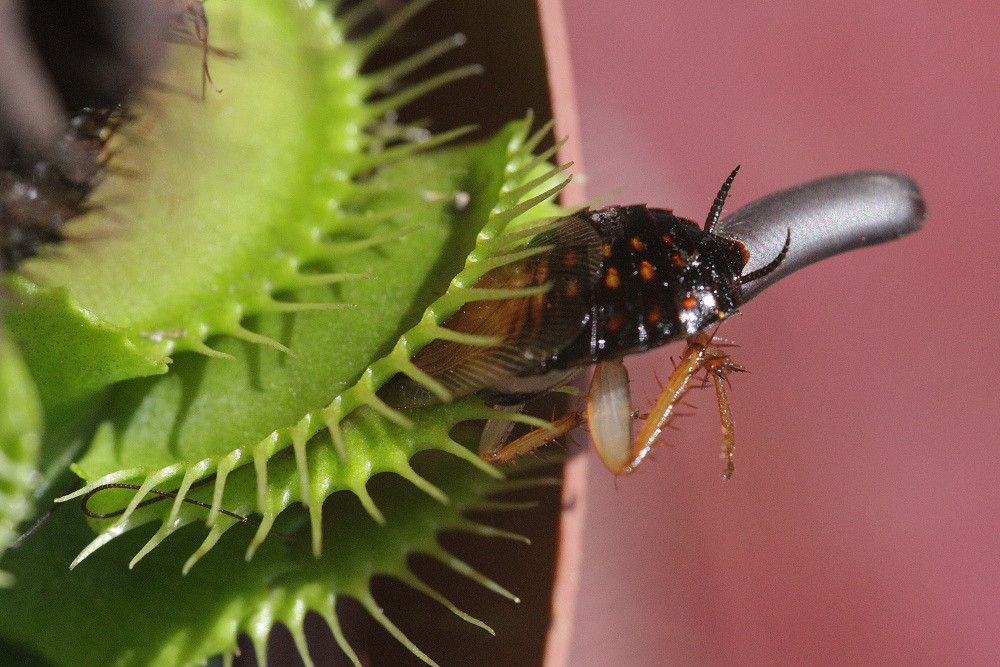
A big catch!
What looks like a silver blob behind the cockroach is actually an egg sac/pod. Cockroaches carry these pods around for a while before dropping them to hatch. The visible legs were still moving a day after it was captured, then the trap won. The egg pod dropped off after another day.
Once the trap reopened, the cockroach remains looked really gruesome. Its head had come adrift from the thorax.
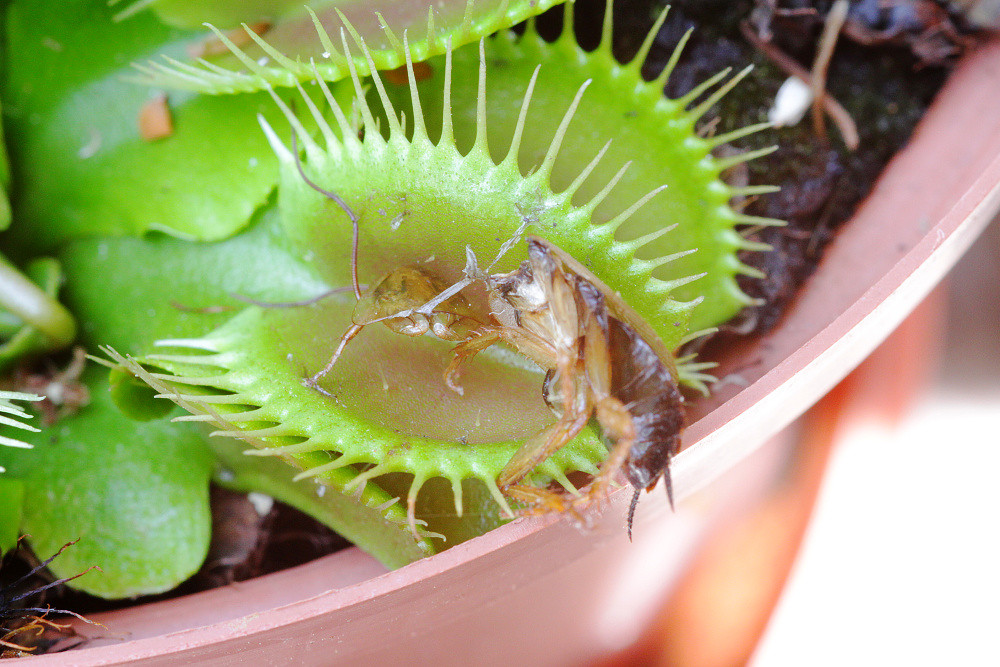
The remains
(25 September 2026)
Back to the Venus Flytrap page
