Gadgets
Fly Repellent Fan
Introduction
When preparing or serving food, flies are often a major nuisance. Some time back, I came across an advert for a fly deterrent fan which I thought looked promising, but I did feel it was rather expensive at the time. Cara set me thinking about these fans again sometime early in 2024. The fans she had in mind were rather expensive (~R500), and I wasn't too keen on paying that amount of money for something I wasn't sure would work.
Some time later while shopping at Pick and Pay, I saw a similar one for R150, which was more in my price class. I bought this to try and was impressed that it actually did work. I soon realised that one of these fans was not enough to cover a set table, as the effective radius of the fan is roughly ½m (about twice the length of one of the fan's blades). This prompted me to look for more, but unfortunately, Pick and Pay no longer had these fans in stock. A bit of searching yielded a pair of fans on Takealot for marginally more than the one I had bought from Pick and Pay.
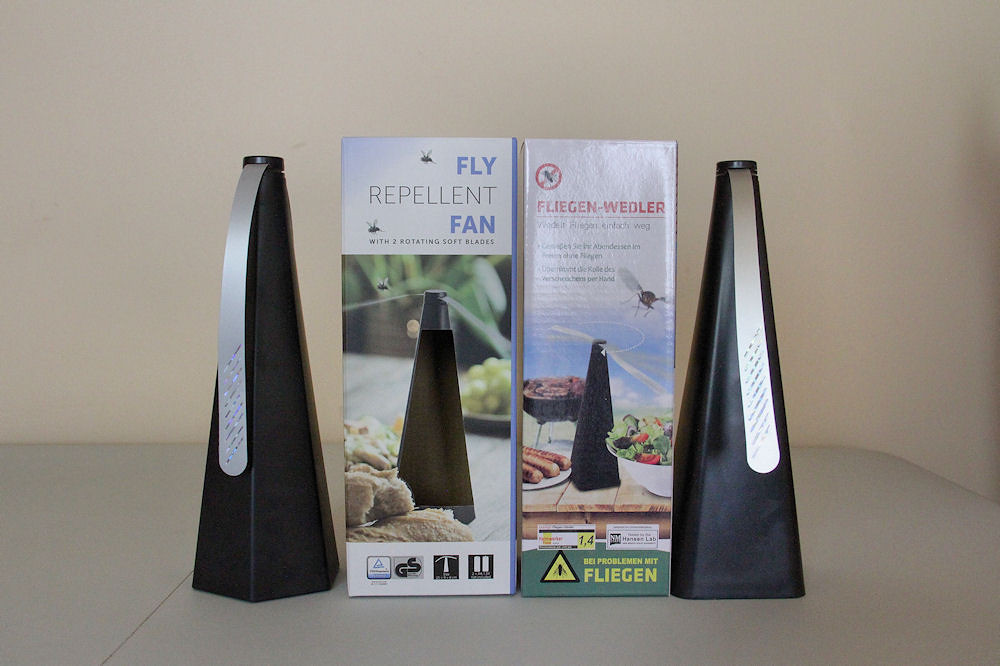
The Fly repellent fan from Pick and Pay on the left and the one from Takealot on the right
How does it work?
The fan works through spinning and the presence of light refracting patterns on the ends of the blades (sales blurb often refers to these as holographic, but whether these are holograms is another question). The pic below shows these patterns through the fan motion being frozen by the use of a flash.
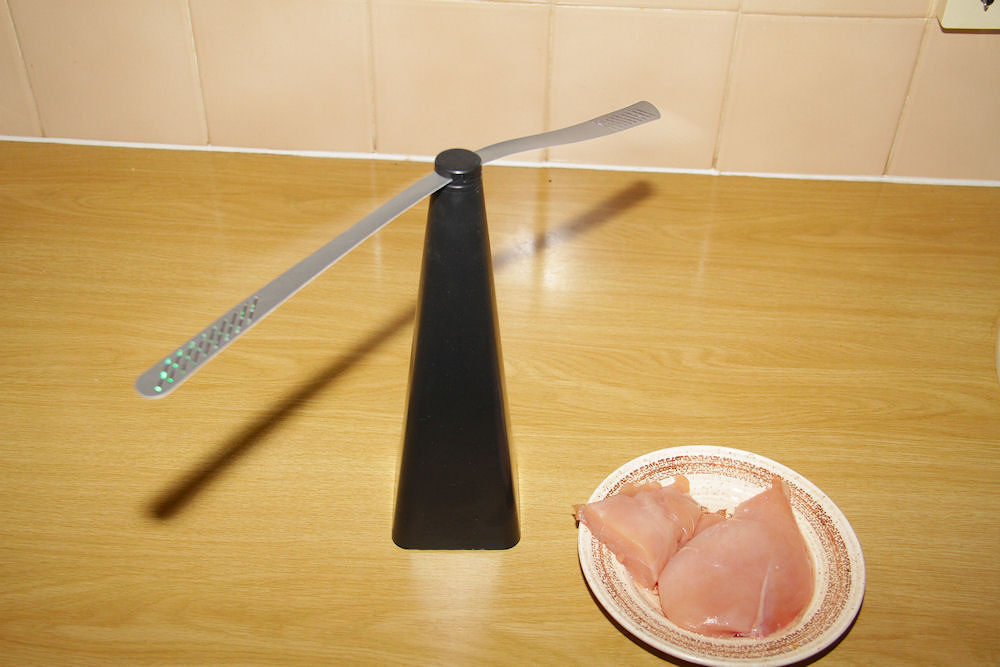
The patterns on the blades
With a relatively slow shutter speed, the effect of light on the patterns can be seen as a series of coloured streaks. The human eye cannot resolve these streaks.
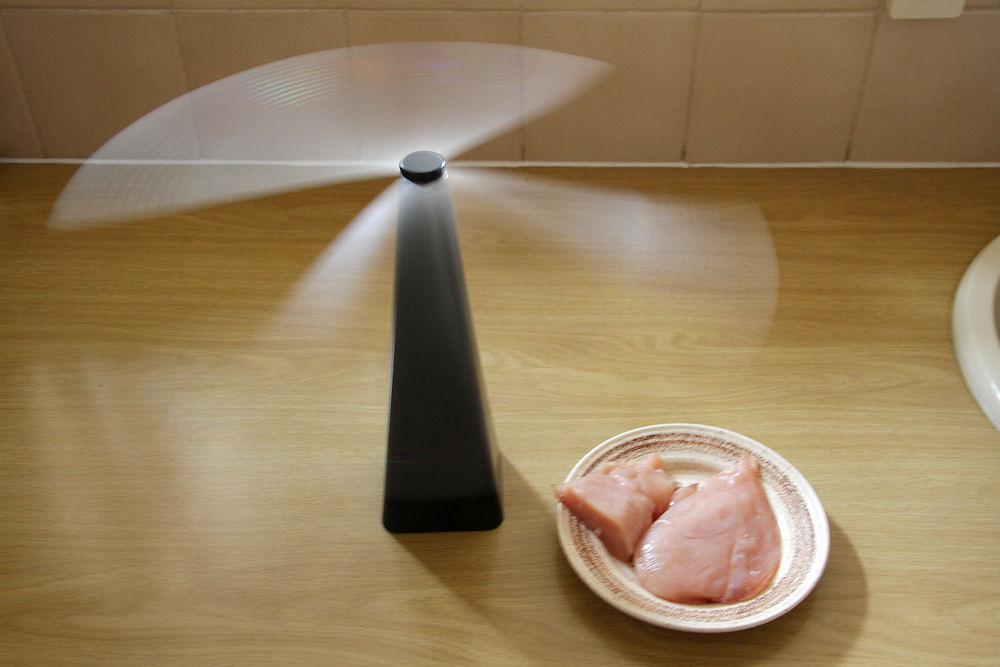
The patterns in motion
The light reflected from these patterns can be seen from a crop of the top left corner of the previous pic.
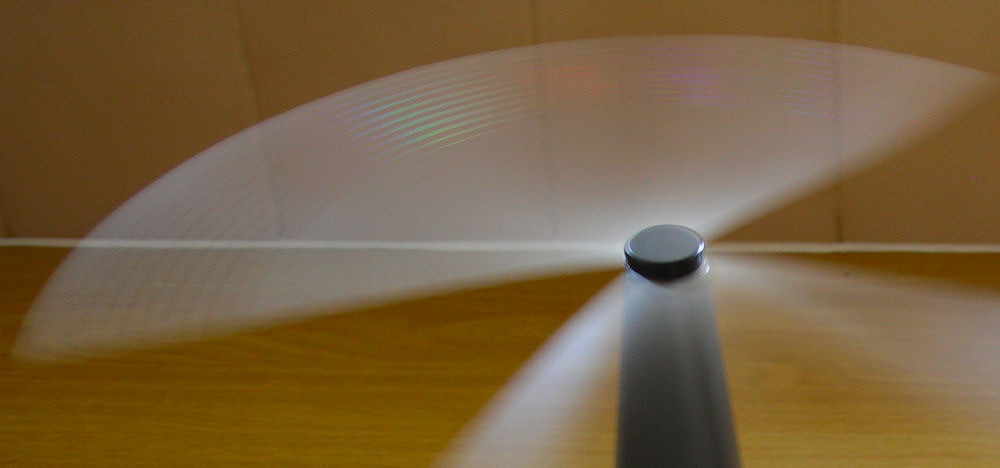
A crop of the previous pic
The colours of the reflected light changing with the angle of the incoming light shows that the patterns on the blade are of a prismatic nature.
Final thoughts
This device really has exceeded my expectations - it really does work. The flies know something is available, but are too wary to try and get to it.
The battery life is also better than I anticipated - I would guess at somewhere around 40 hours on a pair of AA batteries. Even when the blades start drooping, the device is still effective at keeping the flies at bay.
(updated: 16 January 2025)
Update (25 March 2025) What I have found to work really well is to use rechargeable batteries to run the fans. The fans each use two AA batteries, so two packs of four batteries leaves me with two spare batteries with my three fans. When a fan starts losing power, I use these spares to replace the rundown batteries and immediately recharge the rundown batteries. So far I have been lucky that two fans have not run down at the same time.
A bit of useless info: non-rechargeable batteries that are no longer able to supply sufficient power to a fan can still run a battery powered wall clock for at least two months.
(updated: 25 March 2025)
