Gadgets
Security Lights
Introduction
A common occurrence in our neighbourhood is petty thieves jumping over garden walls to pilfer whatever has not been locked down. Although I do have gates and walls over 1.8 m high, the jumpers seem to negotiate them like steeplechasers. In order to limit access between the back and front areas of the garden, I have 2.2 m high palisade fencing, yet the jumpers still find their way around these obstacles.
I am looking at security cameras, but these are quite expensive and often require a cloud-based subscription for video storage, which adds even more cost. As an interim measure, I bought some security lights, which are activated by a motion sensor, from Temu. These lights are solar powered, so theoretically should require minimal maintenance. Two lights cost less than R150 (with discounts), so I felt they were cheap enough for my tests.
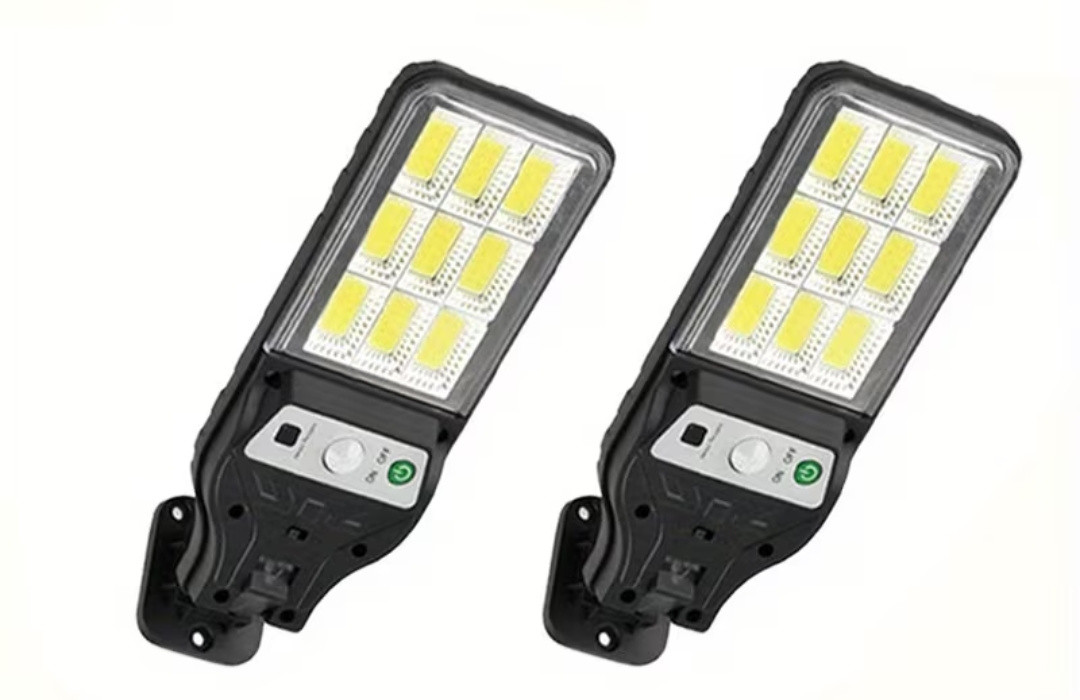
Security lights
Overview
Each light comes with a mounting bracket with screws and wall-plugs.
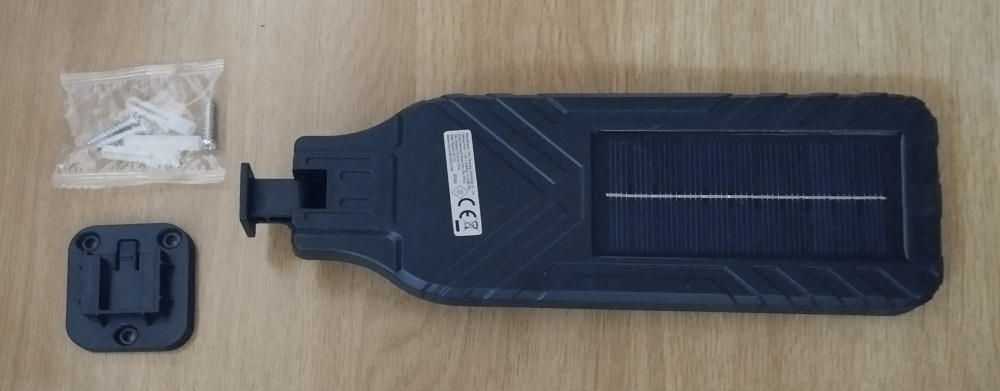
Fig A: Security light, showing the solar panel, with bracket and screws
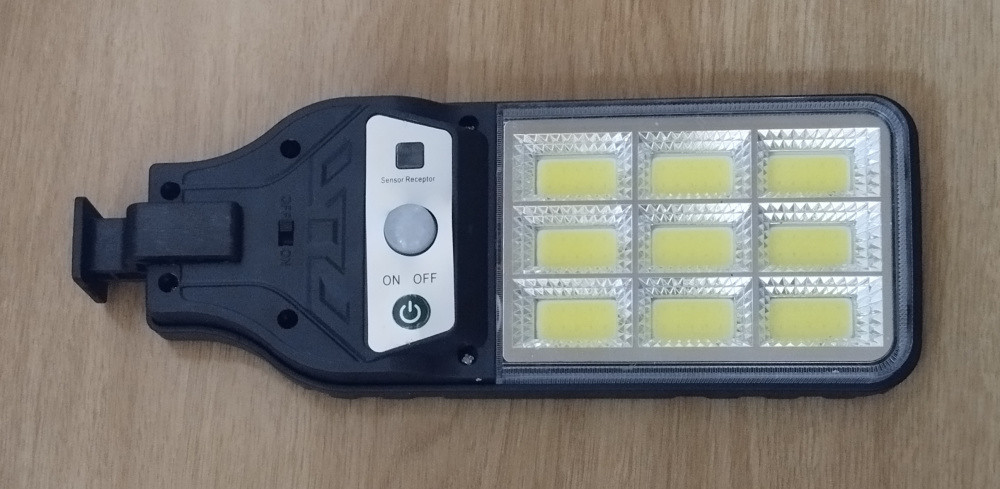
Fig B: Security light, showing the LED bulbs and the controls
To the left of the white panel in the photo above is a small on/off switch (it may be a little difficult to see as the colour blends in with the casing). This controls the power to the entire unit.
The white panel has two detectors and a button marked on/off. As far as I can tell, the top detector is the motion sensor (labelled Sensor Receptor) and the ball-like white one is the daylight sensor. The switch marked on/off actually controls the operating mode. There are four possible modes:
- off
- bright when motion is detected, otherwise off
- dim until motion is detected, then bright
- dim all the time
What I thought was the motion sensor is not. See the tear down below.
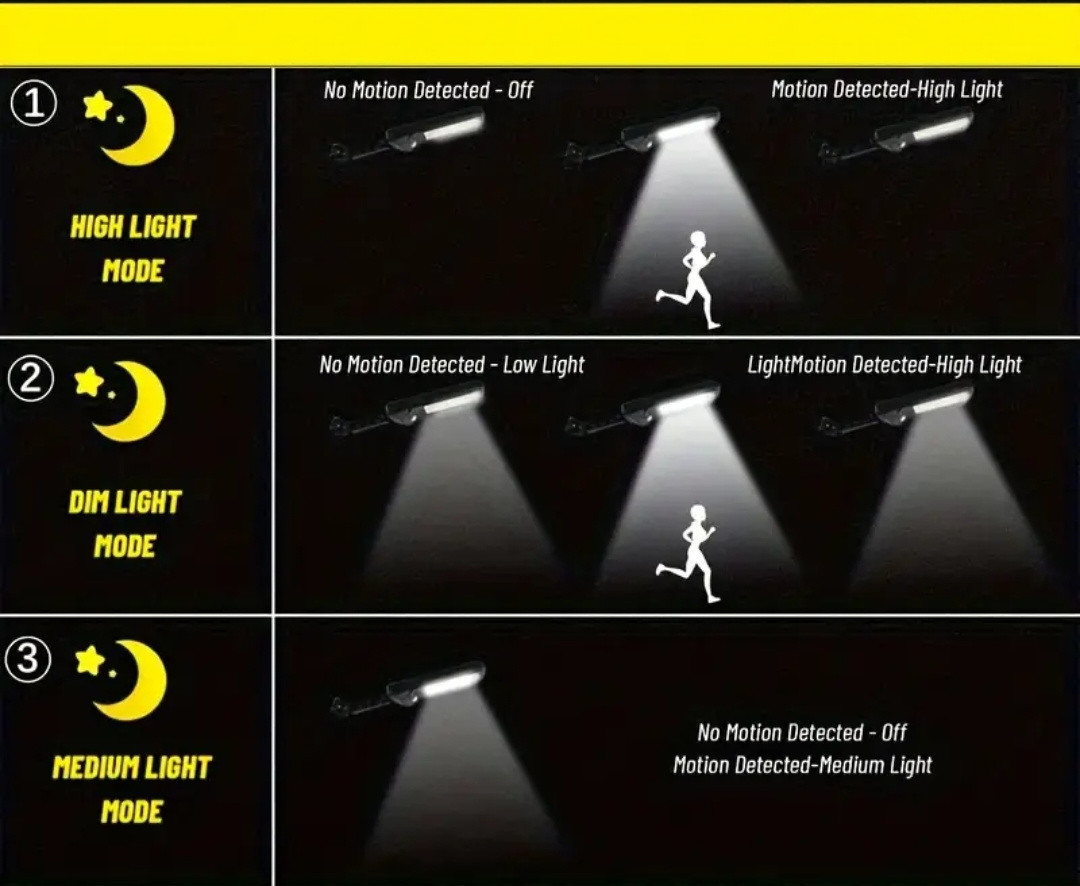
Diagram from Temu showing the modes
The mode referred to as Medium Light Mode in the image above does not work as advertised:
No Motion Detected — Off
Motion Detected — Medium Light
Instead, the light remains dim all the time, without motion detection.
Mounting
I mounted one of the lights to a wall using 50 mm hammer plastic screws instead of the supplied screws and wall plugs.
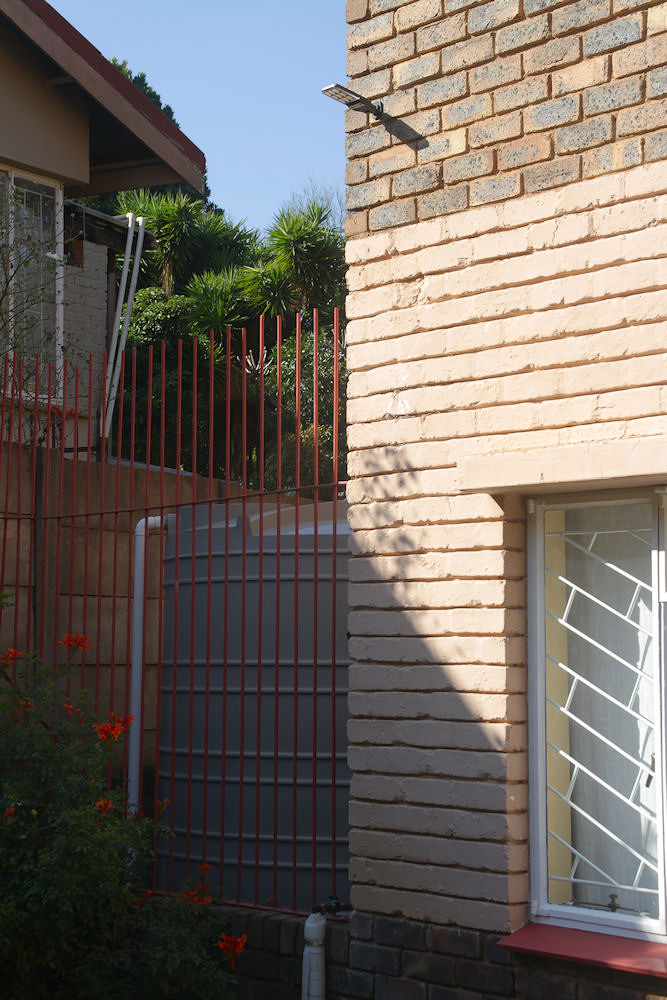
Fig C: Showing one of the lights mounted on the wall
In this photo, you can see the security fencing between the house and the boundary wall. The light itself is in full sunlight throughout the day, which should be sufficient to keep the battery charged. Time will tell how quickly the plastic housing and the battery will degrade under these conditions.
The second light was mounted on the side of an awning on the path to the back garden. This was fixed with three 4×12 mm nuts and bolts.
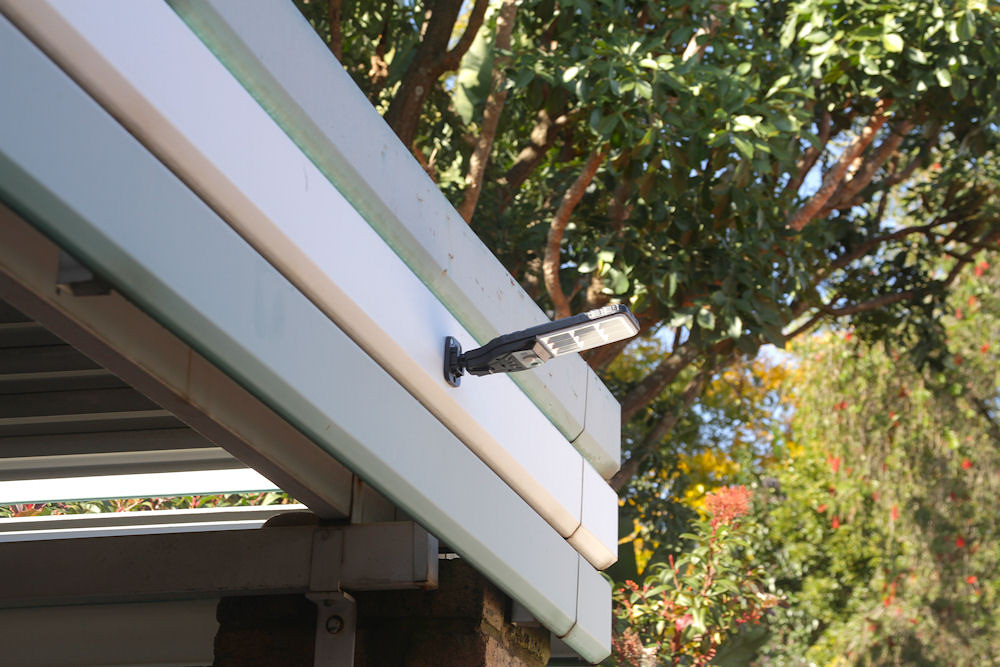
Fig D: The other light mounted on the fascia of the awning
The solar panel of this light is in full sunlight from about 10:00. The light was deliberately placed in this position in order to be able to access the controls from the patio, to test the various lighting modes. Unfortunately, any jumper (if tall enough) will also be able to access the controls, or even steal the light 😒
The light can swivel vertically to give the motion detector a wider field of view. However, the further the light is angled away from the horizontal, the less sunlight will fall on the panel. This is a disadvantage of any solar powered light where the panel is part of the unit.
A worrying thing is that the solar panel is recessed into the housing. When it rains, water will collect in this recess, so one hopes the quality of the weather sealing is up to standard. I have angled both lights slightly, so most of the water should drain away.
During the last big storm, which included hail, the light shown in Fig C was knocked from its set position of 30° above horizontal to 0°. In spite of what must have been a fairly hefty whack, the light is still working.
9 October 2026
(updated: 3 June 2026)
And then reality intervened. The light shown in Fig D died after a period of particularly miserable weather, during which we had about five days of heavy overcast. The other light (Fig C), sitting in the same weather, is still working perfectly. I therefore don't think it is unreasonable to suspect that one of the lights has simply failed.
I tried to return the failed light for a replacement, only to discover that it was already 98 days after purchase and therefore outside Temu's 90-day return window. Apparently, in Temu-land, a 90-day return period is also a 90-day equipment warranty. Once those 90 days have passed, the product can apparently die with impunity. 😒
I had been waiting for warmer weather before doing the more detailed testing, including measurements and photographs. Having discovered that one of the lights has failed and that getting a replacement is apparently not an option, I have rather lost interest in completing the exercise. Why spend time carefully measuring the performance of a pair of lights when one of them has already given up the ghost?
10 September 2026
Tear down
Considering that I had, for all intents and purposes, a piece of unusable plastic junk, I decided to open it and see what was inside. As can be seen from Fig B above, this was not too difficult as there were six screws holding the cover in place.
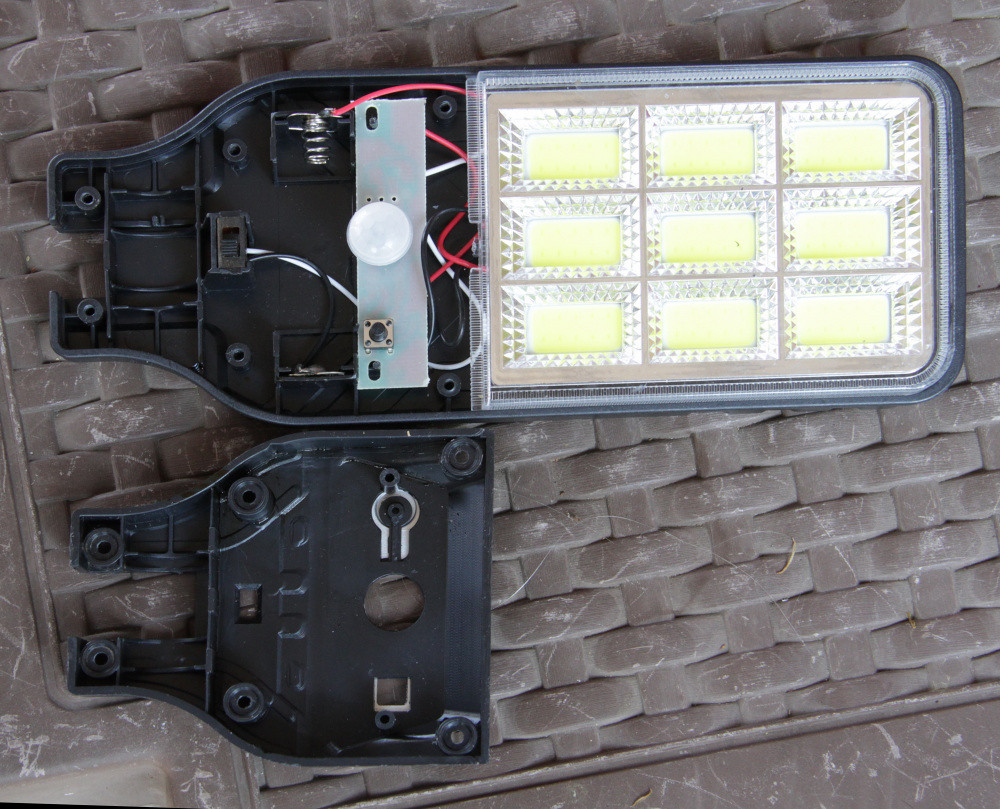
Fig E: Cover and battery removed
The first thing that is immediately obvious is that there is no detector below the little window marked Sensor Receptor. This means that either the ball-like sensor handles both motion detection and daylight sensing, or it is the motion sensor and daylight sensing is handled by the voltage from the solar panel.
On opening, both the positive terminal of the battery and the cover had droplets of a brown watery substance on them, which looked suspiciously like a leakage from the battery. Although there is no gasket around the cover, it is recessed into a slot in the housing, so I doubt whether water could have leaked in through the Coandă Effect.
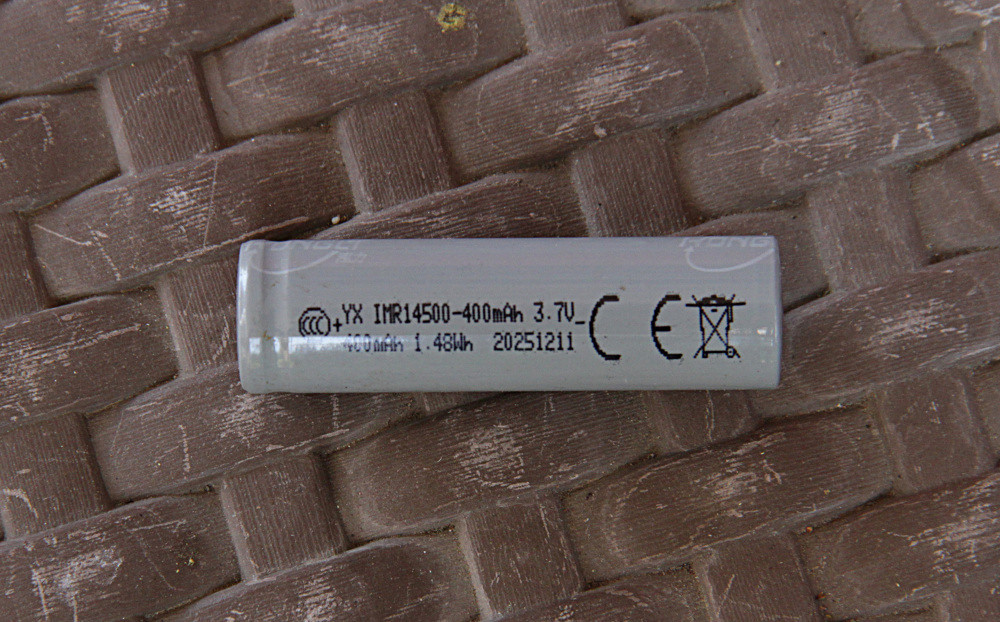
Fig F: The battery
The battery seems to be a fairly commonly available model, IMR14500, 3.7 V nominal. However, the capacity at 400 mAh seems rather low. Many that I could find locally are around 500 mAh and cost more than the whole unit.
For the sake of completeness, and to check whether the battery or the circuitry was at fault, I did some voltage measurements:
- Battery only: 2.67 V
- Battery in position with panel face down: 0.704 V
- Panel in shade, but strong light: 3.58 V
- Panel in direct sunlight: 5.65 V
To me, these numbers clearly indicate battery failure.
I have managed to source an ICR14500 battery (1000mAh) from a local electronics shop, relatively cheaply. They do not stock the IMR14500. So far, this battery is working as expected.
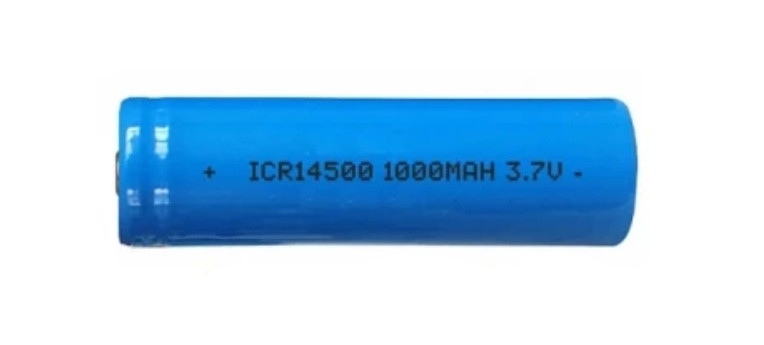
ICR14500 battery
Unfortunately, the device failed again, a mere six days after installing the new battery. During the course of the sixth night, there had been a very light drizzle (<½ mm), which seems to have triggered the failure, making me think that water ingress could be the problem, although I found no water in the device after dismantling it.
28 September 2026
27 September 2026
Mini performance analysis
Due to the failure of the battery in one of the lights, I don't particularly want to analyse this product in too much detail. I share a few points here, when using the light in "bright when motion is detected, otherwise off" mode.
- A cat can trigger motion detection
- The trigger detection distance seems to be about 1.6 m from a vertical line through the light (with the light at ~30° above the horizontal)
- The light remains on for about 20 s
The following images shows the amount of light given off. Do be aware that the dynamic range of the camera is nowhere near as good as that of the human eye.
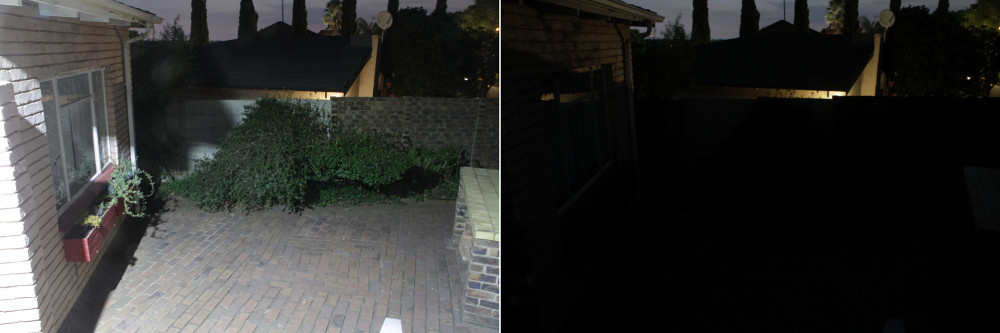
Light on (L) and light off (R)
The shot conditions for the two pictures were the same.
Canon 7D; Sigma 18-125mm; ISO 1000; t = 15s; F/13. Manual focus (TTL). Tripod: Manfrotto 055CLB. Head: Manfrotto MH804-3W.
The second light, which is identical to the one which failed, continues to work perfectly. In addition to showers earlier in the year, it has now survived a major storm, including hail, followed by another smaller storm, with around 30 mm of rain in total.
29 September 2026
27 September 2026
