Games
Catan: Fishermen and Prospectors
The people of Catan prospered and learnt new skills. The first was fishing. The fishermen could trade their fish for other resources. The second was gold prospecting. Deposits of gold were discovered along the rivers and in the swamps where the rivers flowed into the sea. These rich alluvial soils prompted the settlers to build settlements on the swamps. Like fish, gold could also be traded for resources, but it was far more valuable.
Introduction
This is a new game based on the Catan base game and the Catan: Traders and Barbarians expansion. It uses some of the rules from our Catan house rules and some inspiration from John and Chris's giant Catan game.
My games are old, so the rules I follow might not necessarily be current: Catan base game v 3071 (2015) and Traders and Barbarians v 3067 (2008). I bought the base game second hand on an auction on the BoB Shop and Traders and Barbarians new and unopened from Tabletop Guru.
Additional pieces required
- 2 edge pieces (a method to make these pieces).
- 7 numbered disks (there are six spare unnumbered disks, so only one needs to be made). The numbers on these disks are:
- 4 to 10; and
one sharing 3 and 11.
I did try adding letters to the back of these disks as an aid to placement, but this system failed to resolve adjacent duplicate numbers on the board. It is far easier to place the disks randomly and manually resolve any issues.
Standard Pieces
- All pieces from Catan Base Game, except the dice are used (see footnote below).
- The two Monopoly cards are removed from the Development Card deck (we play with resource cards face up, so these give an unfair advantage). One Knight card is also removed, as there is now a preponderance of them relative to the total number of Development Cards.
- 2 spare 2:1 resource harbour tokens (optional – see layout below)
- Event cards (see footnote below)
- Bridges
- All fish pieces, except the boot
- Lake hex
- River hexes
- Oasis hex (used as a wheat hex)
- Glassworks hex (used as a forest hex)
- Wealthiest settler card (Poorest settler cards are not used)
- Harbourmaster card
- Gold tokens
- The following hexes are in play:
- Seven river hexes which include
- Two swamp hexes
- Two mountain hexes (ore)
- Two quarry hexes (bricks)
- One pasture hex (sheep)
- Five forest hexes (wood)
- Five wheat hexes
- Four sheep hexes (five in total)
- Three brick hexes (five in total)
- Three ore hexes (five in total)
- One lake hex (fish)
- One desert hex (robber)
- Seven river hexes which include
- Number tokens
- There are 25 number tokens:
- Three each of numbers 4 to 10;
- Two each of numbers 3 and 11;
- One token shared between 3 and 11; and
- One each of numbers 2 and 12.
- Number tokens are placed on all hexes except
- The two swamp hexes
- The desert hex
- The lake hex which has its own numbers (2, 3, 11, 12).
- The fishing ground tiles, which are placed around the coastline, are numbered 4 to 10.
- There are 25 number tokens:
Layout
- The two new 2 hex edge pieces are placed between the 3-3 and the 6-6 locking points of the standard edge pieces.
- New edge pieces:
- A fishing ground tile is placed on one of hex vertices which is not a harbour;
- A 3:1 harbour is placed on the adjacent side (I have printed these on my new edge pieces).
- River hexes:
- The mechanics of the game requires a fishing ground tile on the edge of the hex where a river flows into the sea (the swamp). The easiest way to do this is to ensure that the river does not flow into a harbour. Having the river flow into a harbour requires:
- the harbour be replaced by a fishing ground tile;
a harbour of the same type be placed on the river side of the harbour as shown below.
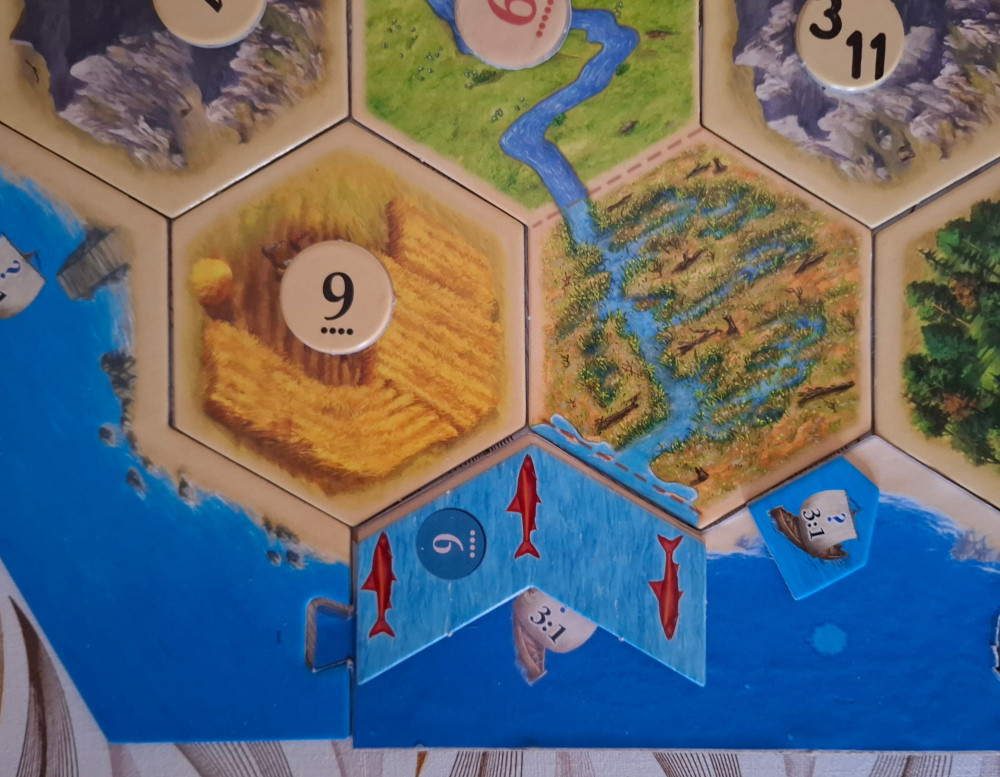
Replacing a harbour with a fishing ground tile
- The swamps should be placed as far as possible from each other .
- Avoid having the sources of the two rivers adjacent as this leads to an unfair advantage as far as gold collection is concerned.
- The mechanics of the game requires a fishing ground tile on the edge of the hex where a river flows into the sea (the swamp). The easiest way to do this is to ensure that the river does not flow into a harbour. Having the river flow into a harbour requires:
- Place the remaining hexes on the board with both the lake and the desert away from the sea.
- The remaining fishing ground tiles should be spread around the coastline.
- Place the number tokens on the board. Resolve adjacent values and red tokens manually.
- Optional: replace two 3:1 harbours with two randomly drawn 2:1 harbours.
In the pic below, you can see how the new edge pieces fit into the board. By chance, the lake hex (fish), the glassworks hex (forest) and the oasis hex (wheat) ended up together in the centre of the board.
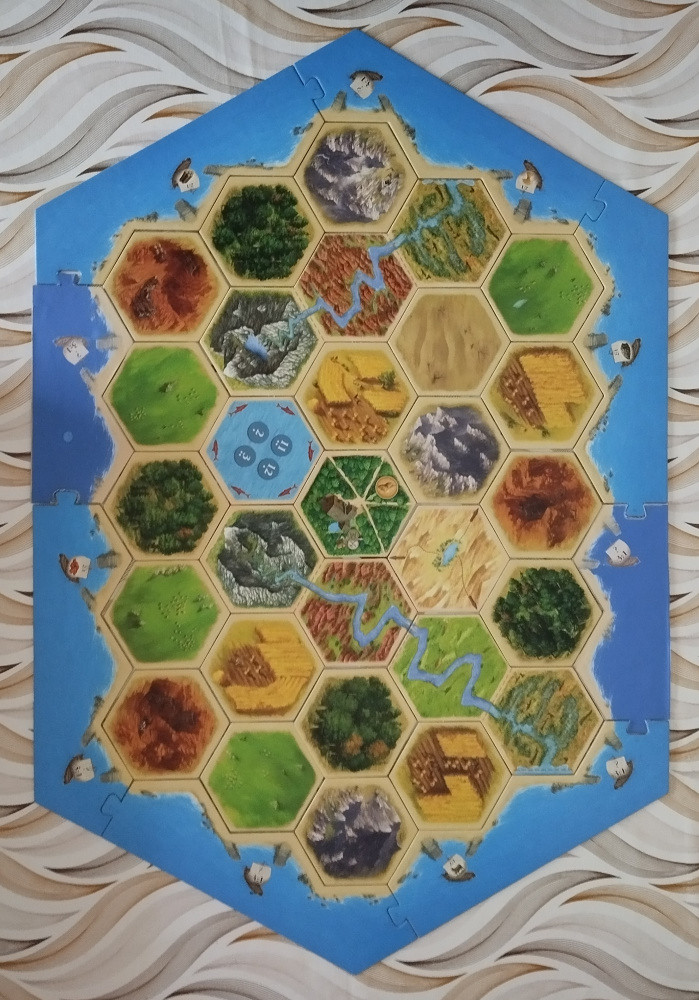
A board layout (without numbers and fishing ground tiles)
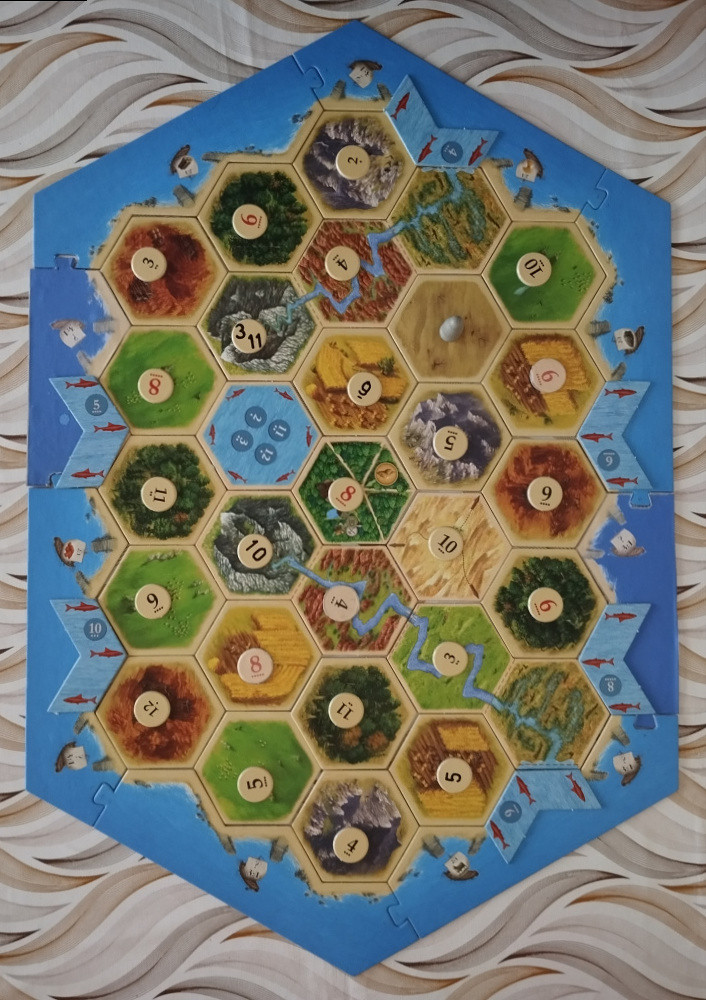
A completed board layout
In spite of my efforts to try and minimise adjacent duplicate numbers with the letters on the reverse side of the number tokens, this particular board had fours pairs of adjacent numbers, which I shuffled around.
Gold
- Rules for collection of gold in The Rivers of Catan scenario (Traders and Barbarians) apply.
- Placing a settlement on a vertex which touches two hexes, each with a river, yields two gold (only one gold is given according to the rules).
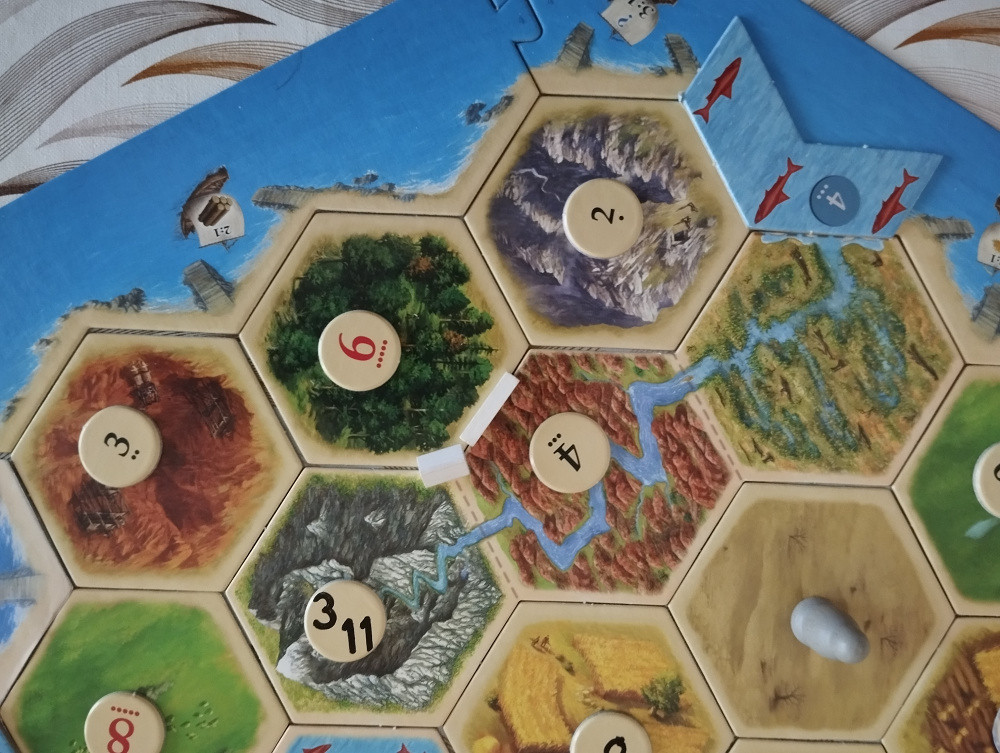
A settlement which receives two gold
- A settlement on a swamp hex yields one gold per turn, on the owner’s turn
- A city yields two gold on the owner’s turn (during an Epidemic event, only one gold may be claimed).
- A player may only claim for one settlement/city on a swamp hex.
- If a player has a settlement/city on both swamp hexes, he or she may also claim for the settlement/city on the second swamp hex.
- If the active player fails to claim the gold during his or her turn, that gold is lost.
- If the robber is on a swamp hex, no gold may be claimed for the settlement/city (see additional rules below).
- A player may use two gold to move the robber during his or her turn.
- Four gold may be used to buy a development card.
- Five gold may be used to bribe the robber, so as not to lose resource cards, if a seven event card is drawn. This may be done during any player’s turn.
- There is no limit to the number of gold transactions carried out during a player’s turn (gold transactions are limited to two per turn in the rules).
- Wealthiest Settler card
- The first player with five gold at the end of his or her turn, may claim the Wealthiest Settler card.
- This player holds the card until another player has more gold, and the card is then given to that player.
- The card remains in play even if players have less than five gold.
- As with other victory point cards, if another player has the same amount of gold, the player holding the card, retains the card.
- If the player holding the card spends his or her gold so that he or she is no longer the wealthiest player, the card is passed to the next wealthiest player. If no player can receive this card (two players with the same amount of gold), the card is returned to the bank until a player once again holds five gold.
- Once no player has any gold, the card is returned to the bank, and may not be claimed until a player once again has at least five gold.
- When tallying the final score, and the Wealthiest Settler card is being used in the count, the player must still have the most (or equal most) gold.
Fish
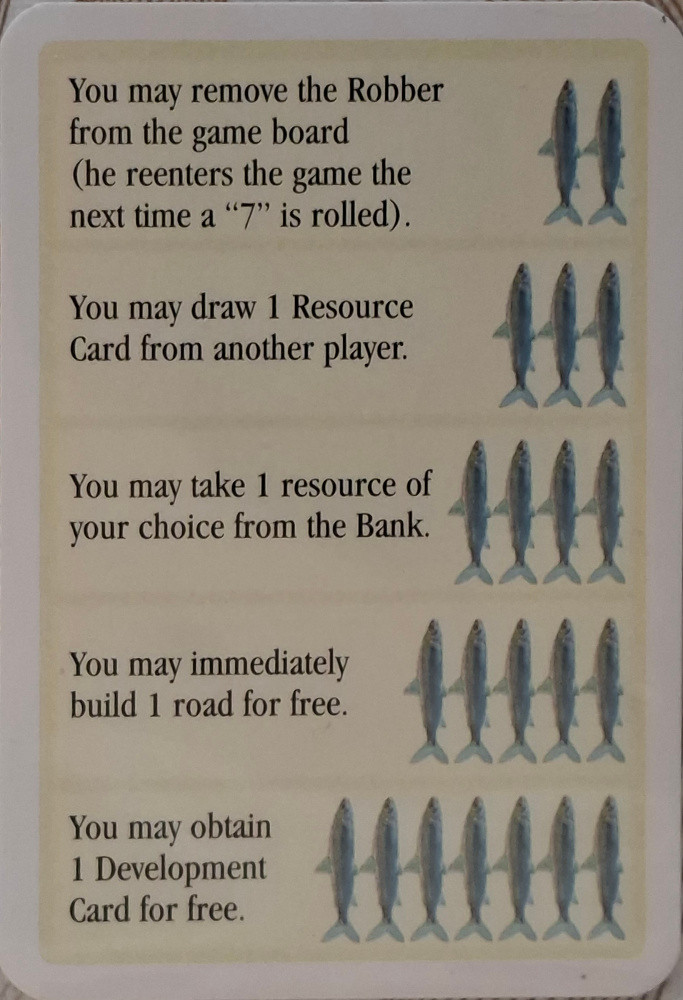
A Fish transaction card
Fish transactions are carried out according to the Fish card, with the following additional transactions available:
- Three fish can purchase one gold (this can be done at any time in order to bribe the robber).
- Six fish may be used to bribe the robber, preventing the loss of resource cards when a 7 event card is drawn. This may be done during any player's turn.
- One gold may substitute for one fish when carrying out a fish transaction (for example, five fish and two gold may be used to purchase a development card).
Additional Rules
- Robber
- Only the active player may move the robber.
- If the active player moves the robber, he or she does so before any other player claims resources.
- The active player may move the robber away from a hex at the start of his or her turn (two gold or two fish or a face down knight development card). Resources/gold for settlements on that hex may then be claimed by all players.
- If the robber is moved from a hex numbered four to the desert, through a Robber Flees event card (4), players may claim resources for that hex.
- If a seven event card is drawn, five gold or six fish may be used to bribe the robber, so as not to lose resource cards. This may be done during any player’s turn.
- If the robber is moved from a swamp hex through a seven event card, the active player may still claim gold for his or her settlement on that swamp.
- If the active player moves the robber to a hex corresponding with the current event number, players with settlements on that hex may not claim resources for that hex.
- If the robber occupies a hex with a harbour, that harbour may not be used for trading until the robber is moved.
- Settlements, cities and roads may be built adjacent to a hex occupied by the robber.
- Gold may be claimed for settlements, roads and bridges built adjacent to a river hex (including the swamp) occupied by the robber.
- The robber only becomes active after the end of the second round. If a seven event card is drawn before the end of the second round, the robber remains in the desert. The player draws a new event card. (See footnote.)
- Development cards
- A player may purchase any number of development cards during his or her turn.
- A player may only play one development card during his or her turn (see exceptions below).
- A development card purchased may be played immediately or hoarded (kept face down) to be used at a later stage.
- Exceptions:
- Two cards may be played if the player can win the game by playing these cards.
- Victory Point cards:
- Must be played immediately by the active player — it does not count towards the number of development cards played in a turn.
- Must be hoarded by a non-active player receiving it from a bonus — it must be played immediately at the start of that player's turn.
- Hanging Roads
- A hanging road is a road adjacent to a settlement which is not linked to another settlement. As this road was probably built by mistake, the player may move it a cost:
- Five gold; or
- Six fish.
- The following applies to moving hanging roads:
- A settlement without roads may not be upgraded.
- A hanging road may not be moved from a city without other roads.
- A hanging road is a road adjacent to a settlement which is not linked to another settlement. As this road was probably built by mistake, the player may move it a cost:
- Initial placement (see footnote)
- Three settlements are placed by each player at the start of a game in the following order:
- AB-BA-BA in a two player game;
- ABC-CAB-BCA in a three player game; and
- ABCD-BDAC-CDAB in a four player game.
- No resources may be claimed on the placement of the first settlement.
- Resources, including fish and gold, may be claimed on the placement of the second and third settlements.
- Three settlements are placed by each player at the start of a game in the following order:
- Victory
- The first player to 15 victory points on his or her turn wins — only the active player may claim victory.
- In a four player game, this may need to be reduced to 13 points.
(updated: 17 August 2026)
Playing the game
We finally got around to playing the board shown above.
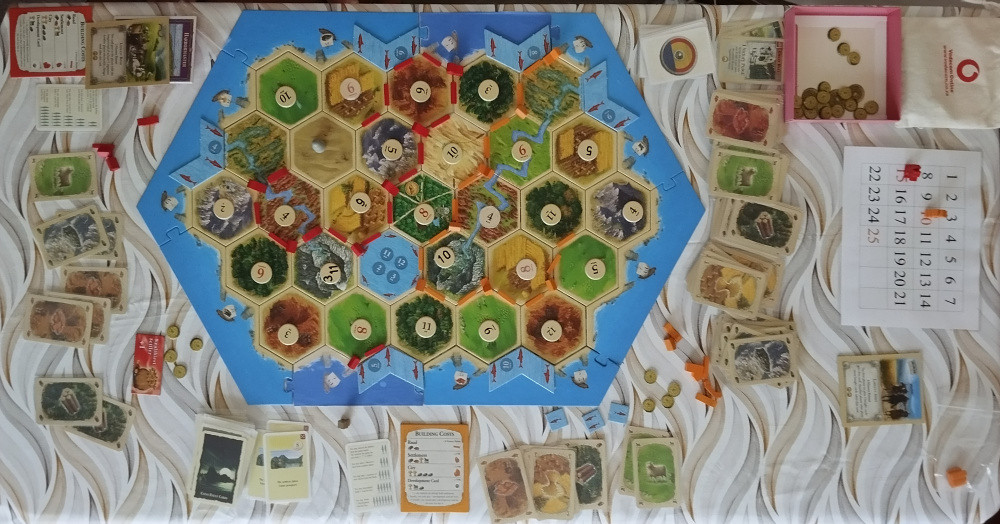
A completed two player game
The red player won quite comfortably. As you can see, there was no real competition for space in this two player game. With three players, space becomes an issue.
When John came around, we played the same board as a three player game.
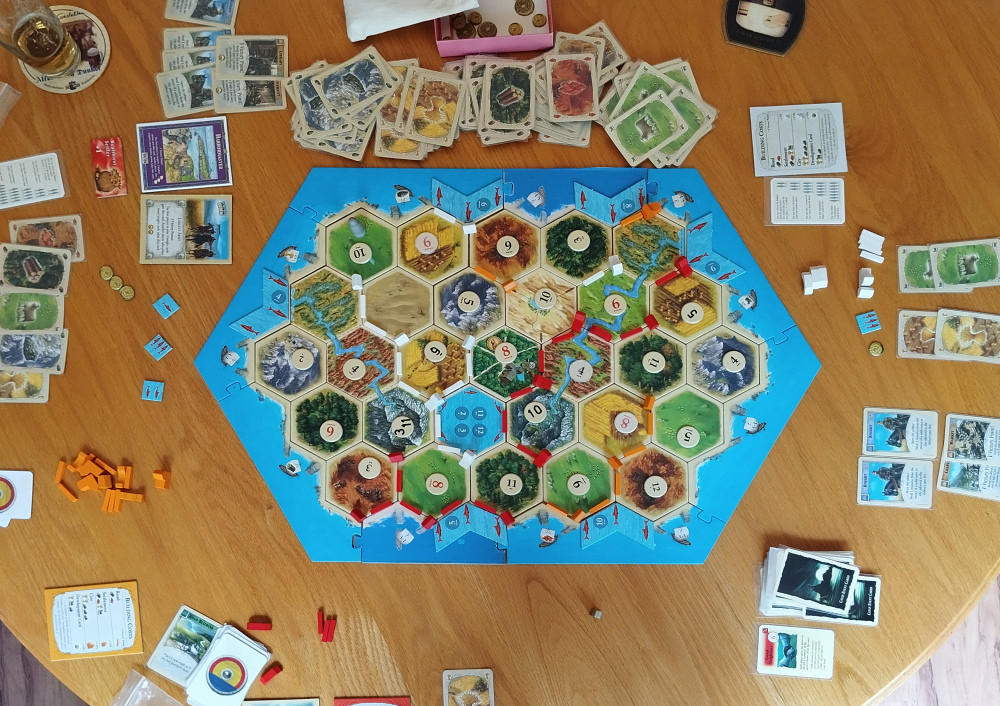
A completed three player game
The (same) red player won the game, but in this case you can see how much more crowded the board has become.
John has been keeping track of the time taken for a three player game, and the average is 1.56 (± 0.40) hours (n=11).
I have not kept times for the two player game, but both Pat and I feel that it is around one hour.
(updated: 25 February 2026)
Footnotes
Event Cards
These were the original rules for using the event cards instead of dice. We now normally use the dice variant described below, but the original system is retained here for players who prefer it. I have added a page showing some stats about dice rolls and event cards.
- There are 36 numbered event cards and one New Year card.
- Event cards are used instead of dice.
- In the deck, the frequency of the numbers on the cards correspond with the probability of a number occurring with a roll of two dice. (eg a 7 occurs six times whereas a 12 occurs once in the deck).
- The cards contain information regarding events which may influence all players.
- During setup, the cards are shuffled and the New Year Card is placed near the bottom of the pack.
- At the start of his or her turn, a player:
- takes the top card;
- reads and resolves the event (if any).
- The number in the circle on the card is then used for drawing resources from the bank
- The event card is then placed on the discard pile
- When the New Year card is reached, the event cards are reshuffled and it is once again placed near the bottom of the pack.
Dice
Recently, we have returned to using the dice instead of the numbers on the event cards, as this adds more variability to the game. We still use the event cards, but have made the following changes:
- All event cards with the number 7 (Robber Attacks) are removed from the deck.
- The New Year card is not used.
During the play, the following sequence is used after the active player rolls the dice:
- If the dice tally is not seven, an event card is drawn and its instructions are followed. Resources may then be claimed according to the dice tally.
- Optional: if the spots on the red die match those depicted on the event card, all players may choose one of the following bonuses:
- One resource card; or
- Two gold; or
- Three fish; or
A development card may be purchased at the cost of:
- One resource card (ore, sheep or wheat); or
- Two gold; or
- Four fish.
The development card bonus was introduced because players tended to ignore these cards during the game. The additional purchasing option gives players another incentive to acquire them at a considerable discount.
- If the dice tally is seven, the active player moves (or bribes) the robber and the robber penalties are implemented. Options:
- No event card is drawn; or
The Robber Attacks event cards are placed in a separate stack and one of these cards are drawn. If the spots on the red die match those depicted on the card, one of the bonuses listed above may be claimed by all players.
The card is then placed at the bottom of the stack (and not on a separate discard pile).
- If the dice tally is seven before the end of the second round, the active player continues rolling the dice until the dice tally is not seven.
Initial placement
We originally used the initial placement rules from John and Chris's Giant Catan game, in which each player begins with three settlements and three roads. We have now reverted to the standard Catan setup of two settlements and two roads, except that resources are collected for both initial settlement placements.
This change was made to discourage the tactic of initial placement of settlements on both swamps. While this remains a viable strategy, it now requires more careful resource management and makes achieving the Longest Road more difficult.
The order of placement is as follows, with A being the player to start the game:
- AB-BA in a two player game;
- ABC-CBA in a three player game; and
- ABCD-DCBA in a four player game.
(updated: 20 July 2026)
