Gadgets
TDS Meter
Introduction
As part of my interest in Venus flytraps, I have become more and more curious about water quality. A Venus Flytrap needs water with a very low TDS (Total Dissolved Solids) level. Up to now, I have been using distilled water, but having split my plant into three, distilled water becomes very expensive (about 5 L per month, for one plant, at R73 per 5 L bottle). I needed to find a cheaper source of water, even if it wasn't as pure as distilled water. In order to do this I needed a TDS meter to measure what was the purity of the water that I could get my hands on.
TDS meters available in South Africa are rather expensive, so this prompted me to look on Temu. I ended up buying a very cheap one with the thought that if it worked, I would be happy, if it didn't, I wouldn't have lost too much. Fortunately, the meter I bought shows values that I expected from the water that I tested.
The TDS is measured by passing a small current between two electrodes and by measuring the current flow, determine the TDS from a built-in look-up table. From what I can gather, the look-up table is based on NaCl dissolved in water. I will do my own calibration test in the near future.
Please be aware, as the name suggests, a TDS meter gives an indication of the amount of solids dissolved in the water - it cannot measure biological contaminants, such as bacteria.
This is a short note to show what I have found with regard to TDS levels from various water sources.
The meter
Like all Temu items, the TDS meter was neatly packaged and came with a legible (and understandable) set of instructions. It also comes with two button batteries which are insulated from each other with a plastic strip.
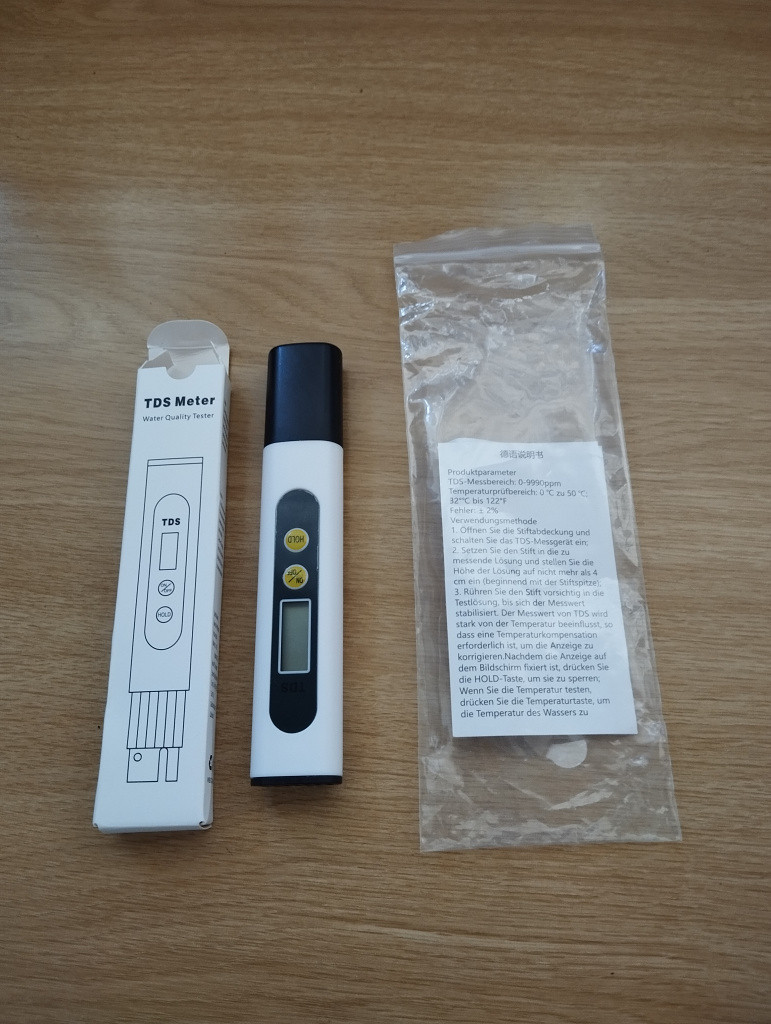
The TDS meter with its packaging
There are two buttons on the meter - an on/off button and a hold button. The hold button locks the reading when the meter is removed from the water.
On taking the cap off, the two electrodes can be seen in their protective housing.
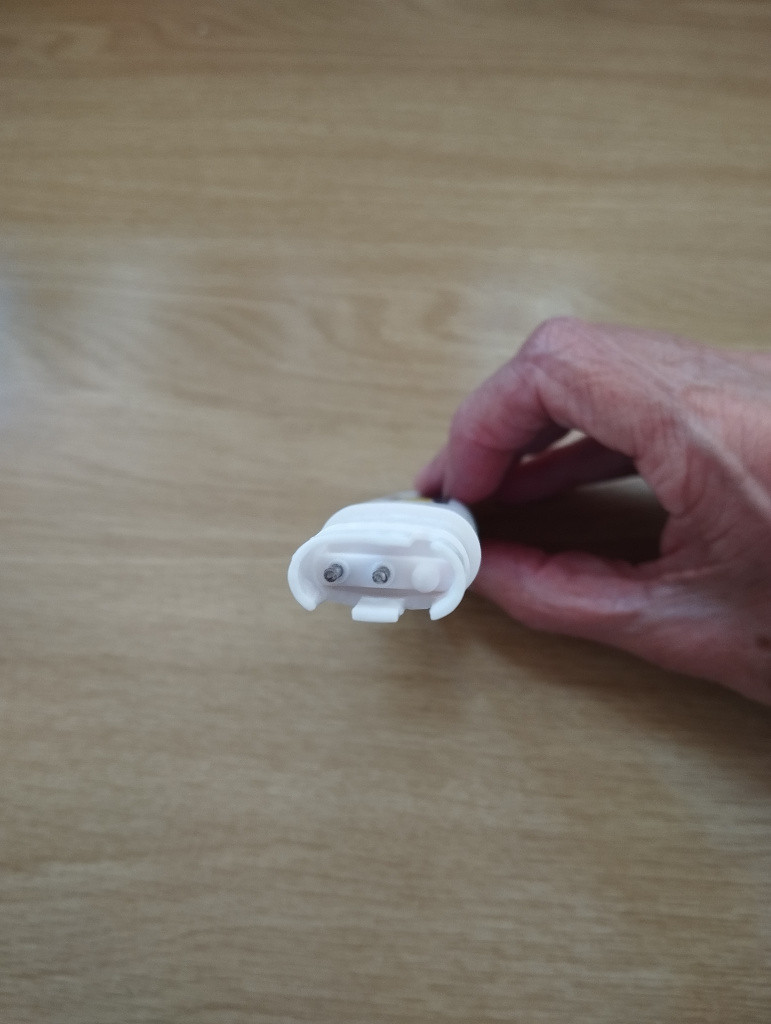
The electrodes of the TDS meter
The meter is placed in water to take a reading.
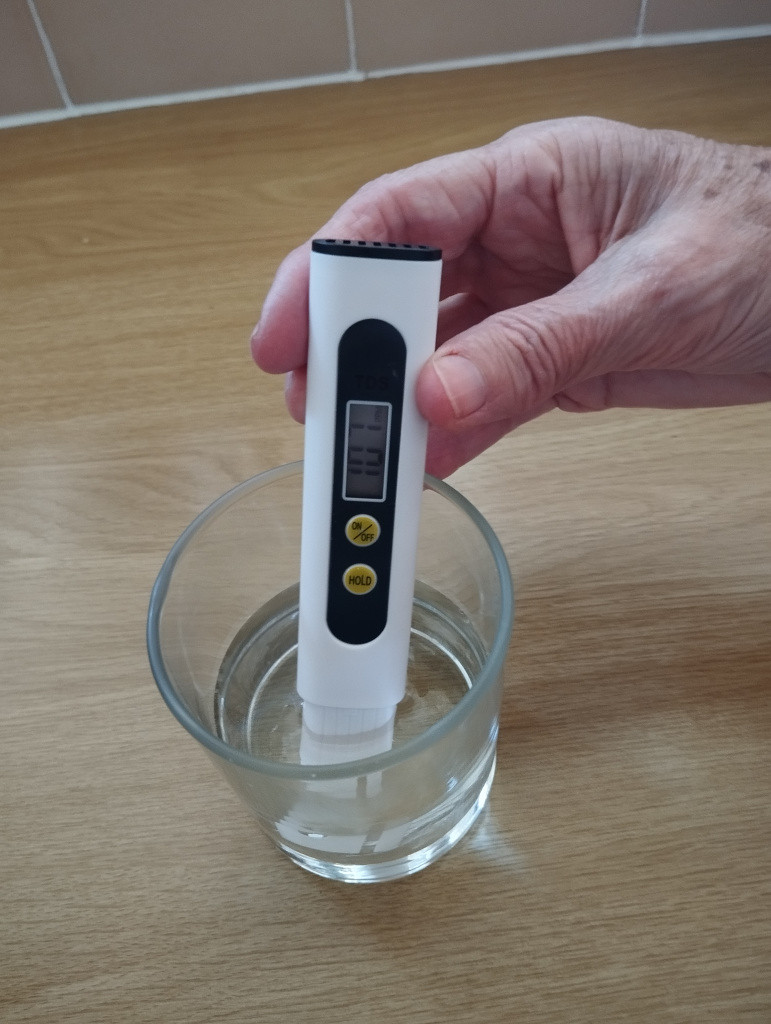
Taking a measurement with the TDS meter
Readings are given in parts per million (ppm) and range from 0 and 999: 1 g of table salt dissolved in 1 L of distilled water equals 1000 ppm.
Measurements
I measured the TDS from several different sources. I will discuss each source below the table.
| Source | Value (ppm) |
|---|---|
| Distilled | |
| Water Shop | |
| Supermarket | |
| Rain | |
| JoJo | |
| Tap | |
| Filtered tap |
Distilled As expected, distilled water should be the purest water. This came from Dischem and cost R73 for 5 L.
Water shop The Perfect Water shop close by sells water filtered by reverse osmosis. The value of 2 ppm was obtained from the refill line in their shop. Water from a 5 L pre-bottled container (R21) measured 1 ppm. Refilling containers costs R8 per 5 L, which is a bargain.
Supermarket The water was Aquazoi Alkaline Water bought from the local Spar at R22 for 5 L.
Rain The rainwater was collected in a clean glass bowl, away from any objects which could cause [possibly contaminated] water to drip into the bowl. The value is higher than I expected, but the air in Pretoria is very polluted.
JoJo The JoJo is our rainwater harvesting tank. As the water collected is runoff from the roof, one cannot expect it to be ultra-pure.
Tap The measurements I have made on tap water varies between 101 ppm and 116 ppm. This is an acceptable level for drinking water according to the WHO.
Filtered Tap Since I started brewing beer, I have used in-line water filters to [hopefully] improve the quality of the water for brewing. Yeast, as a living organism, does not like some of the chemicals added to drinking water to kill bacteria - these chemicals also kill the yeast. I have never checked the effectiveness of these filters until I got the TDS meter. I was shocked that my two stage filter (a 5 μm sediment filter, and an expensive KDF filter) was producing worse results than the tap water feeding the filters. This said to me that one of the filters was probably clogged up and releasing solute back into the water.
I replaced the filters and got almost identical results. This says that either the filter housing is introducing contaminants, or the filters are introducing contaminants. Whatever it might be, we will be using store bought water for drinking in the future.
Recommended drinking water purity levels
For the sake of completeness, I include a list of the WHO's TDS purity levels for drinking water (this list comes from Gemini as it was quite difficult to find a page showing these values on the WHO website).
The ideal and safe TDS levels for drinking water are primarily based on taste (palatability) and general safety for human consumption, which involves finding a balance of desirable minerals without excessive levels of contaminants.
Water with very low TDS (below 50 ppm), such as highly purified or distilled water, is safe but can taste flat or "insipid" because it lacks minerals.- Ideal Range (Excellent Taste): Generally considered to be 50 - 150 ppm (mg/L). This range provides a crisp, refreshing taste due to a healthy balance of minerals.
- Good to Acceptable: 150 - 300 ppm. The taste may be slightly more "minerally" but is still pleasant and safe. Acceptable (EPA Secondary Standard Limit): The U.S. Environmental Protection Agency (EPA) has a secondary (non-mandatory) standard of 500 ppm as the recommended maximum limit, primarily to prevent noticeable taste, odor, and staining issues.
- Poor Taste/Cautionary Range: 500 - 1,000 ppm. Water in this range is often described as having a strong or unpleasant taste (salty or bitter) and may cause scale buildup in pipes and appliances. Filtration is often advised.
- Unacceptable: Above 1,000 - 1,200 ppm. Water at these levels is generally considered unfit for drinking due to unpalatability and potential health concernsfrom excessively high levels of salts or other contaminants.
The water from the reservoirs in my suburb are perfectly acceptable as far as the TDS levels are concerned.
Gemini has the following to say about purity levels for a Venus Flytrap:
Venus flytraps (and most other carnivorous plants) are extremely sensitive to minerals and dissolved salts because, in their natural bog environments, the water is nearly devoid of them. High TDS can cause mineral buildup in the soil, leading to "root burn" and eventually the death of the plant.
- Optimal Range: 0 - 50 ppm (mg/L). The lower the better, with 0 ppm being the safest. Water sources that naturally fall into this range are distilled water, reverse osmosis (RO) water, or clean rainwater.
- Acceptable but Not Recommended Long-Term: Some growers report that Venus flytraps can tolerate water with a TDS up to 75 ppm or even, rarely, 100 ppm for short periods. However, using water in this higher range will cause mineral buildup over time, requiring frequent flushing or repotting.
(updated: 27 October 2025)
Testing the filtration system
I decided to do a fairly unscientific test of my filter system to try and figure out where the problem was. My test involved removing the filters individually and testing the TDS. The filters in this exercise were a 5 μm sediment filter and a CTO carbon filter (not a KDF filter).
| Filter | Value (ppm) |
|---|---|
| Tap water | |
| Both filters | |
| Sediment only | |
| No filters | |
| CTO only | |
| Both (after) | |
| Tap (after) |
It is quite difficult to understand what is going on here, but I will try to interpret it.
- The tap water varied between 104 ppm and 108 ppm during the test (about 15 min);
- There appears to have been some contamination in the filter housing which seems to have been flushed out with the removal of both filters;
- The CTO filter did not remove any contamination.
One thing is clear, this filtration system is not working.
(updated: 27 October 2025)
