Blogs
Mealybugs on Venus Flytraps
As I mentioned on my Venus flytrap page, I first noticed these bugs while we were on holiday. The bugs liked sunning themselves on the spine of the trap, so the biggest problem I found was trying to get rid of these tiny things without triggering the traps.
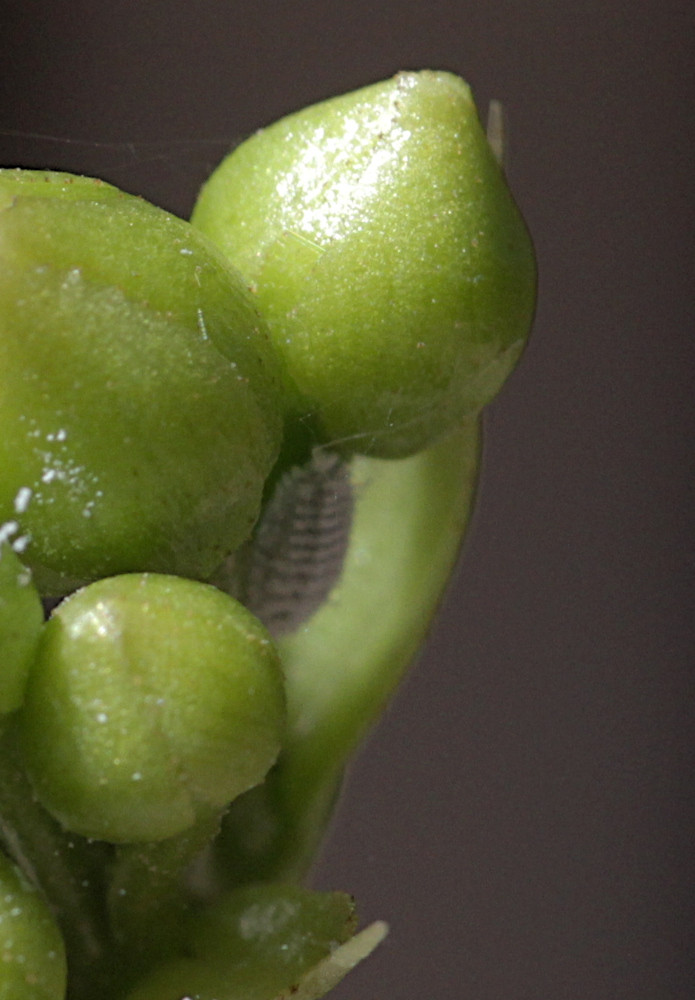
A crop from a pic showing a mealybug hiding in the flower buds
The first thing we tried was removing them with a toothpick, but it was difficult to miss the trigger hairs, especially if the trap was not fully open. I did get rid of a few by putting a fly in such a trap - in digesting the fly, the mealybugs also got digested.
I did find a possible solution on the web, but what worried me about this was putting chemicals (in this case isopropyl alcohol and dishwashing liquid) on an active trap. I felt that these chemicals could get absorbed by the plant's digestive system and as the plant is very sensitive to chemicals, it could kill the plant. The recommended method of swabbing the infested area could also trigger the trap, exacerbating the problem. What I ended up doing was using a syringe to squirt the liquid directly on to the mealybugs - this did seem to do the trick, but it only worked for the bugs you could actually see.
I did query ChatGPT and it gave me the isopropyl alcohol swab method mentioned above, as well as another of placing the whole plant underwater for about 48 hours. This would then drown the mealybugs and their eggs. It would also drown any other bugs (such as spider mites) hidden in the plant's rosette of petioles, or even hidden in the growing medium.
I was wary of doing this as it sounded rather extreme and that I could actually drown the plant as well as the bugs. My mind was set at ease about this when I found an article, (while searching for something totally different) about testing the speed of a trap closing underwater against a trap closing in air. The premise of this is that the plant in its natural habitat is subjected to seasonal flooding, which means the plant would spend time underwater. While underwater, the plant is still able to catch prey. While the article was extremely interesting from a scientific point of view, it did make me feel happier about dunking a plant in a bucket of water!
I used water from the JoJo as the TDS was low enough (16ppm) for this experiment. Interestingly, with the plant submerged, the TDS rose to 27ppm.
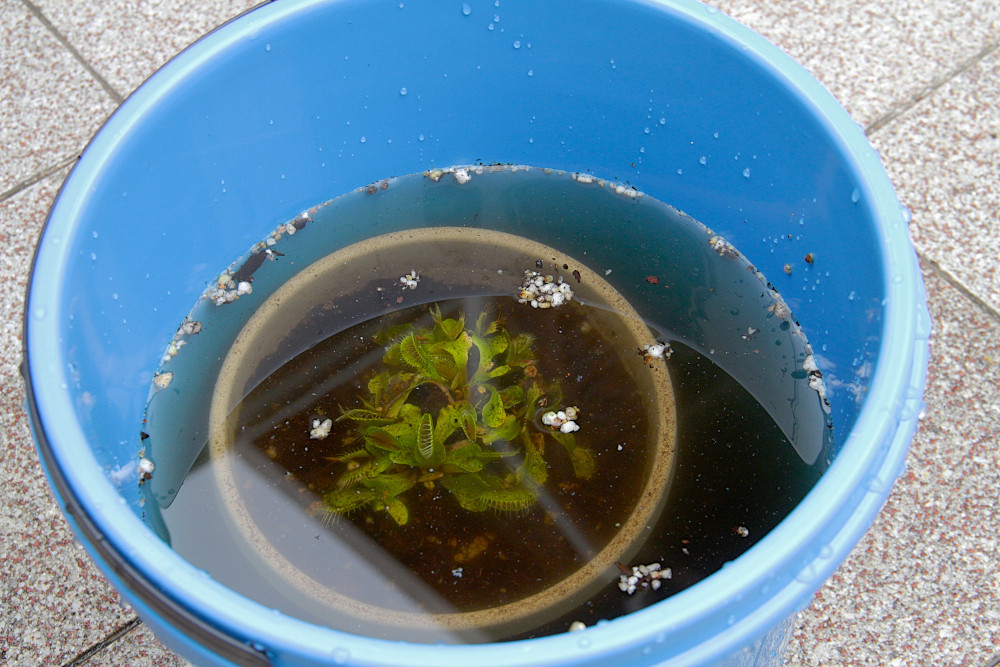
The plant in the beige pot getting a dunking
It was more difficult than I expected to get the plant submerged. The peat moss/perlite mixture is very light, the pot is plastic and the plant(s) weigh hardly anything. Also, there was an air bubble under the pot. Once I got the air bubble dislodged, the pot did stay down. Air bubbles in the petioles also slowly got released.
For some photographic fun, before dunking the plant, I took some pics of two mealybugs that had moved into a newly opened young trap. The trap can be seen in the previous pic as the vertical trap, more or less in the centre of the pic - you may be able to see the bugs.
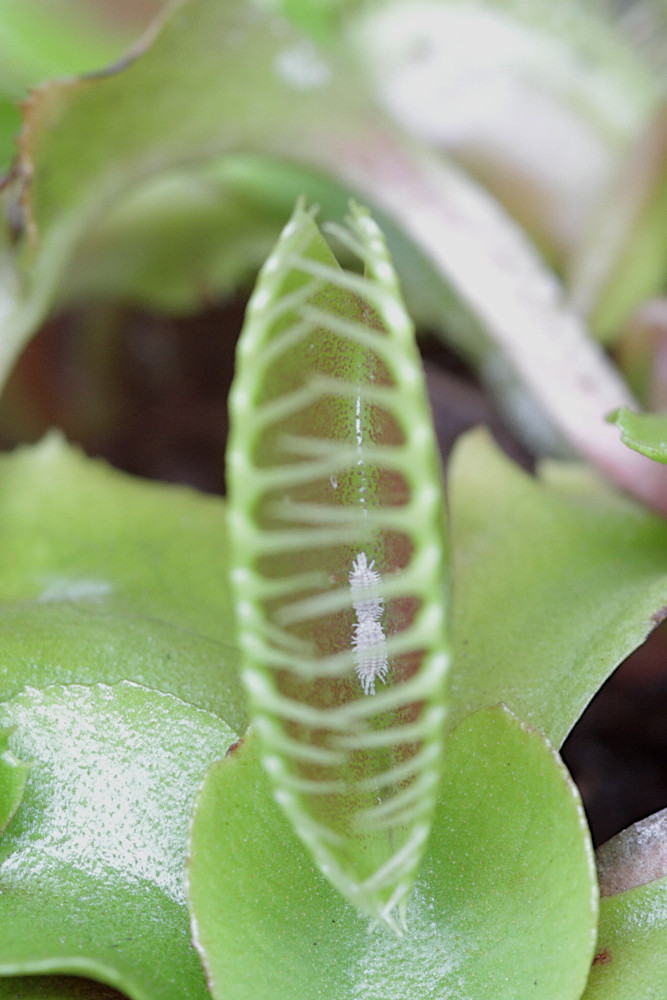
Mealybugs in a trap (cropped into portrait and slightly along the vertical for framing)
Nerdy stuff: Canon 7D; Sigma 105mm macro lens; ISO 640; T = 1/15s; F/9. Manual focus (TTL). Tripod: Manfrotto 055CLB. Head: Manfrotto MH804-3W.
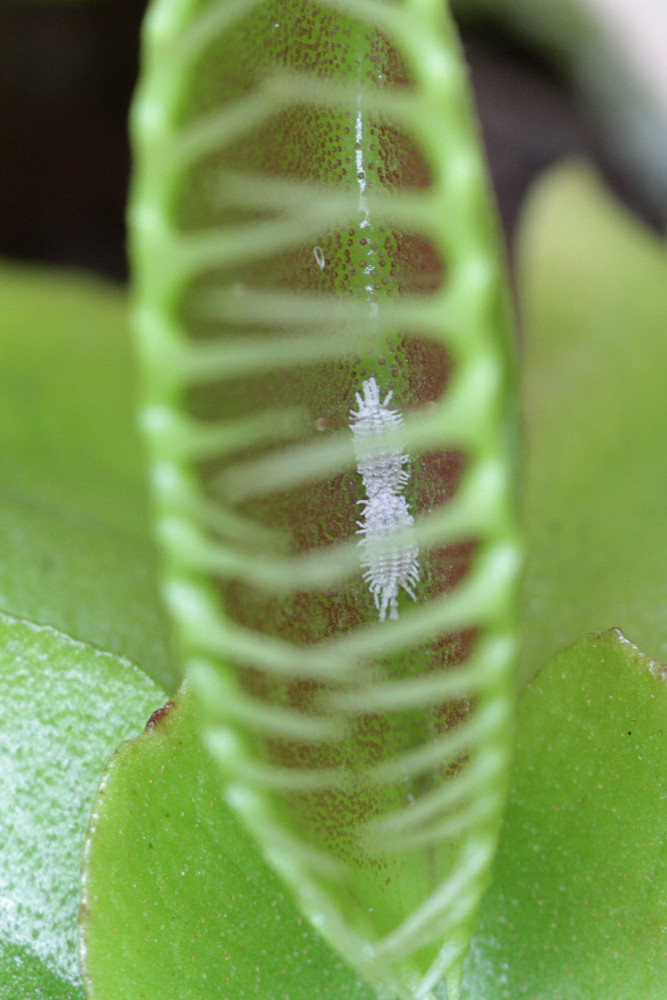
Mealybugs in a trap (cropped into portrait)
Nerdy stuff: Canon 7D; Sigma 105mm macro lens with 68mm of Kenko extension tubes; ISO 640; T = 1/10s; F/9. Manual focus (TTL). Tripod: Manfrotto 055CLB. Head: Manfrotto MH804-3W.
After 48 hours, I took the plant out of the bucket, drained it and flushed it with water from the JoJo. I had to repot the plant again as some of the growing medium had floated away during the dunking. During the dunking, I did see some mealybugs floating around on the surface of the water. I tried to catch them in order to squash them, but that was rather difficult as they moved away from my fingers - probably something to do with surface tension, coupled with the waxy coating on the bugs.
I took a pic of the same two mealybugs shown above as they had not moved during the dunking. The top one seemed to be a husk rather than an insect - maybe it had moulted?
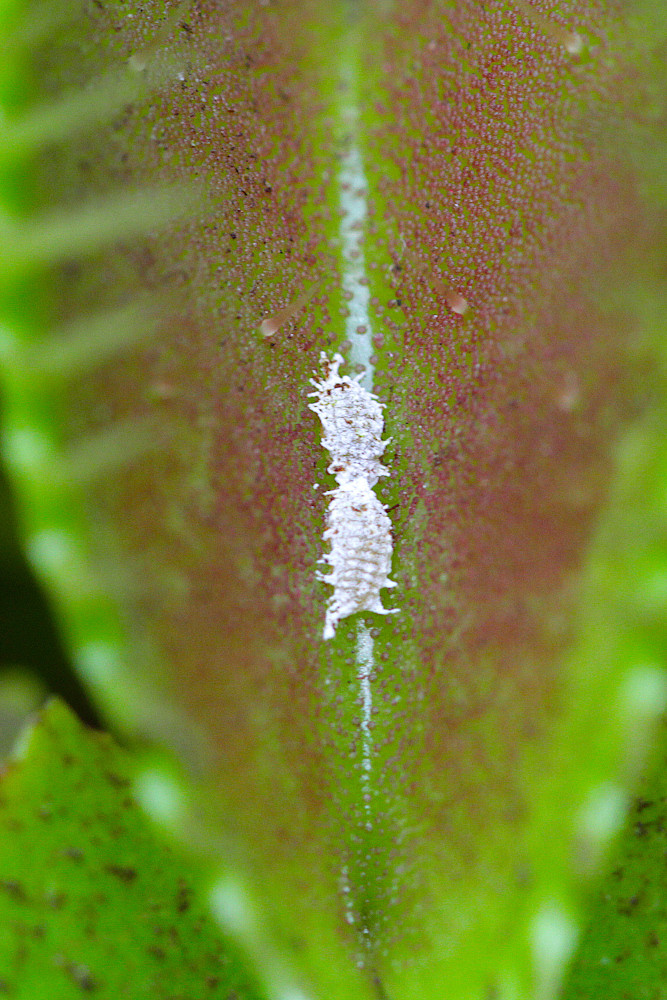
The same mealybugs after dunking for 48h (cropped into portrait)
If you compare the last two pics, you can see that the trap has opened further (and grown) despite being underwater.
Unfortunately, I saw a mealybug moving around on the plant later in the afternoon. The plant was more than a metre away from the other plants, so I doubt whether the wind could have blown it across. This meant that all the mealybugs did not drown...
Lesson learnt: In practical terms, the dunking was only a partial success. It clearly reduced the mealybug population, including individuals hidden in inaccessible places, but it did not eliminate them entirely. At least one mobile mealybug survived, suggesting that some individuals or eggs can tolerate prolonged submersion.What it did demonstrate was the resilience of the Venus flytrap itself. Despite being submerged for 48 hours, the plant continued normal growth and trap opening, indicating that short-term flooding is well within its natural tolerance. If anything, the treatment proved less disruptive to the plant than repeated mechanical interference with the traps.
This poor plant had another major setback — it got blown off a table during a storm shortly after the dunking. The plant and a fair amount of the growing medium were knocked out of the pot in the fall. I replanted it almost immediately and the plant has survived pretty well — Venus flytraps are tougher than you think.
(18 November 2025)
