Gadgets
High Pressure Cleaner: Foam Cannon
Introduction
An attachment that I really wanted for the Trade Professional HP2000 high pressure cleaner was a foam cannon in order to be able to apply soap to a surface being cleaned. Although most web references refer to foam cannons as an accessory for car washing, it can be used to apply soapy foam to any surface that needs cleaning.
In searching for a foam cannon, the first one I found with a connector which looked similar to that of the HP2000 was the Ingco Foam Producer. This foam cannon was available at a reasonable price from Takealot.
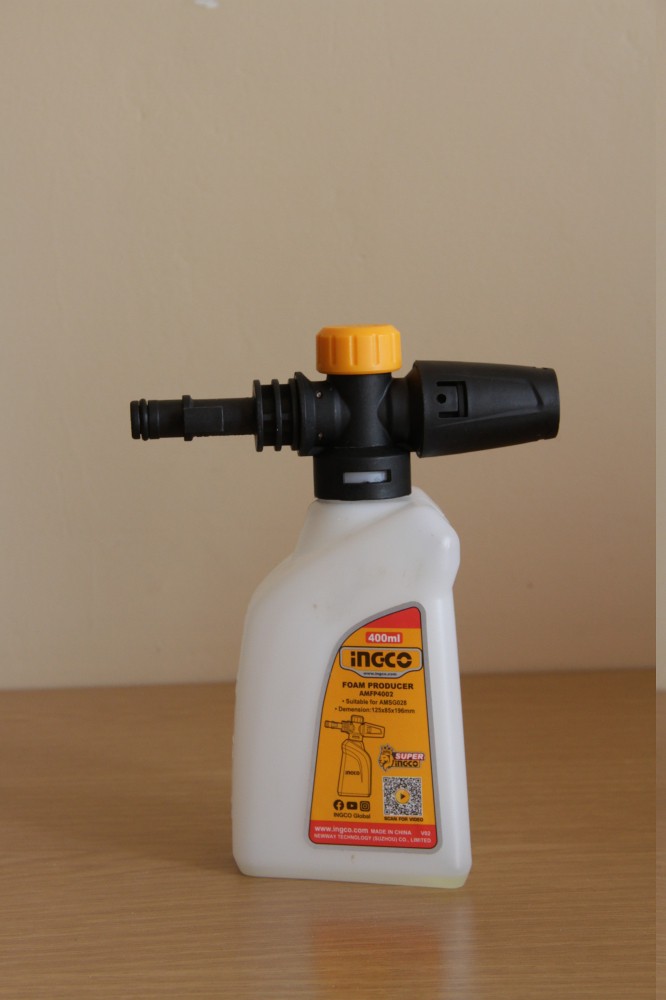
The Ingco Foam Cannon
Unfortuntely, it's not easy to see the bayonet fitting on the connector, but I have discussed the connector in more detail elsewhere. I only realised while trying to find a turbo nozzle how lucky I was that the foam cannon fitted my power washer.
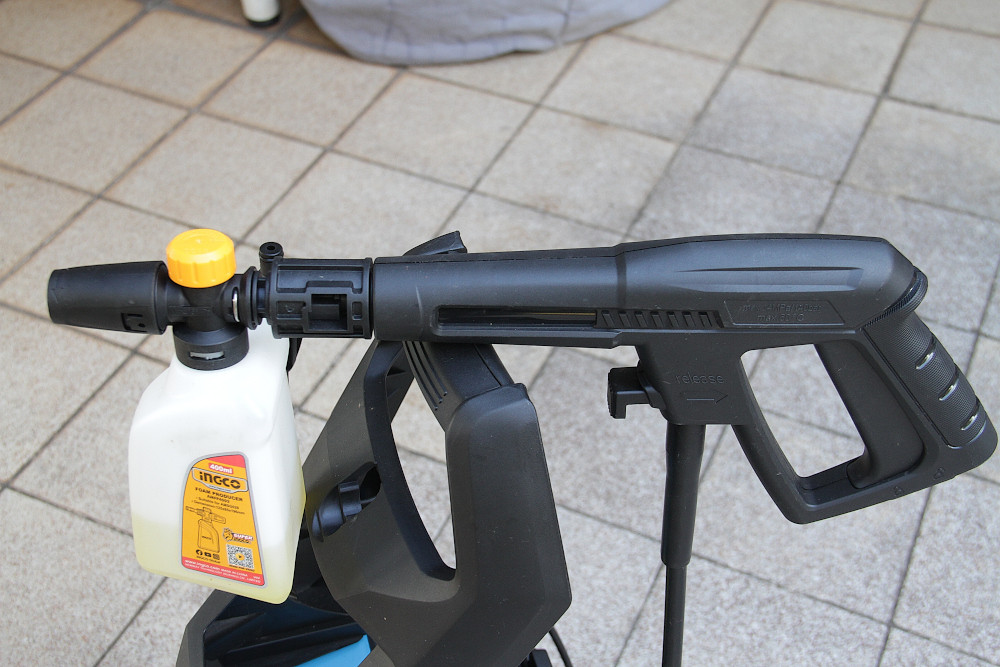
The Ingco Foam Cannon attached to the HP2000's gun
The spray pattern from the nozzle on the foam cannon is fan shaped. The orientation of this fan can be changed by rotating the nozzle. The yellow knob on the top of the foam cannon controls the soap flow (hence the amount of foam produced).
Does it work?
My target for the first test was the rims on my bakkie. These were caked with an exceptionally sticky dried mud after our trip to Marakele Game Reserve.

Muddy rims on the bakkie
In order for the foam cannon to work, you need a soap that makes a decent amount of foam and the only car wash soap that I had on hand was Shield Splash Car Shampoo, so I tried that. As this soap is rather viscous, I decided to dilute it to 50% in the Ingco's container before spraying it on the wheels. (Note that photography was the last thing on my mind, so the pictures don't really tell the story.)
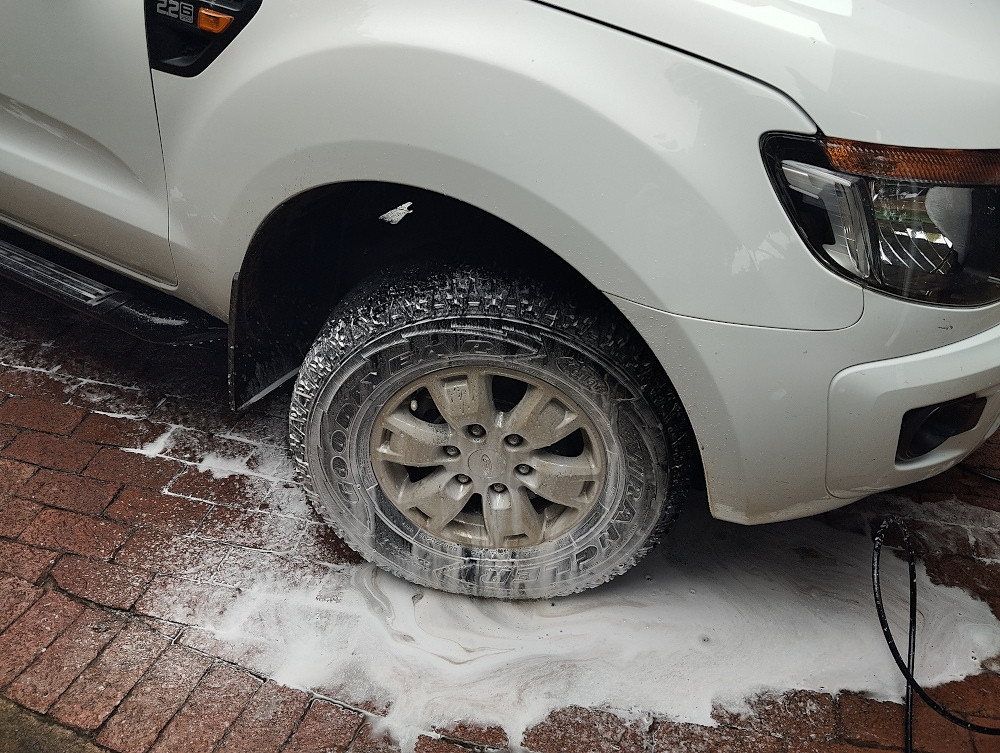
After spraying foam on the wheels
This picture was taken about five mintes after spraying foam on the wheels (I first had to find my phone to take the pic!). As you can see, with the foam draining off the wheel, a great deal of the mud had already been removed. I then used the HP2000's lance on a medium setting to rinse off the foam.
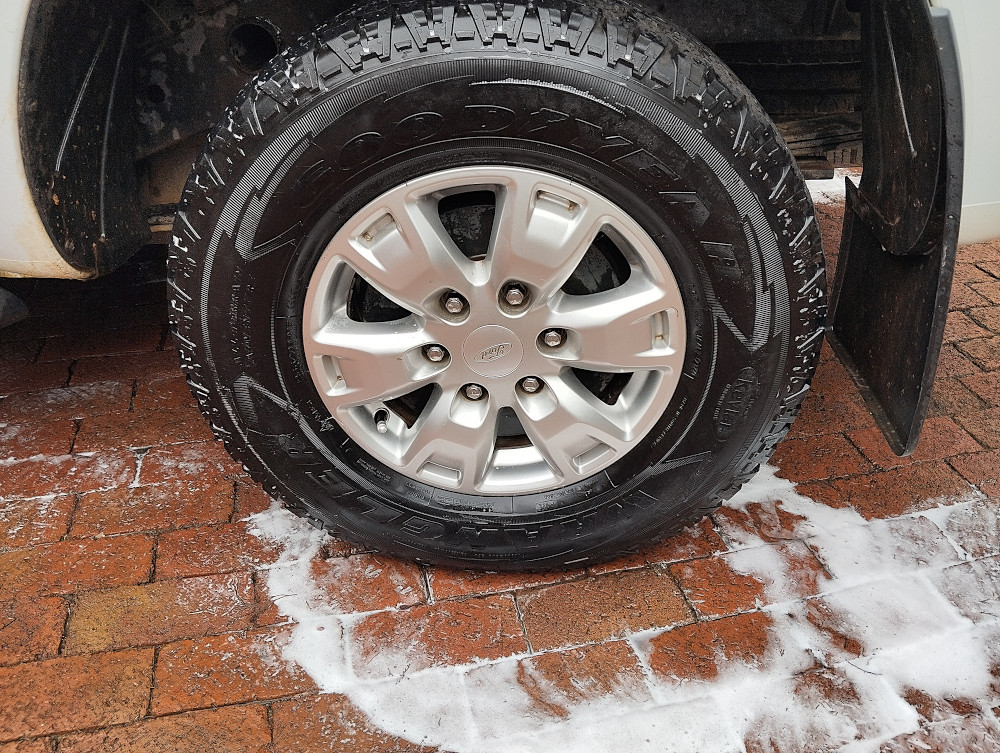
After rinsing the wheels
I was pretty impressed with what I had achieved, with so little effort, by using the foam cannon. In hindsight, I probably won't dilute the car shampoo by quite as much when I use it again.
General Purpose Soap
Now that I have a soap that looks as though it works reasonably well on a vehicle, I wanted a general purpose soap for cleaning other surfaces. I did look at the Kärcher General Purpose Cleaner, but the price at Builders Warehouse at the time was exorbitantly expensive (R300 for 1L - 2 July 2025). On the Kärcher website the same product was R140! We did look at many brands, with a simple non-scientific test - shake the bottle and if it foamed in the bottle, it was worth considering.
Plush Supreme Tile Cleaner As the tiles on the patio were my major target, the first cleaner I tried was Plush Supreme Tile Cleaner. This was on special at Checkers for R35. It made plenty of foam in the bottle shake test, so I bought it to try as it could also be used without the foam cannon. It made beautiful foam when used with the foam cannon, but unfortunately did not lift the grime on the patio tiles.
Loreto Wonder Clean I found this cleaner in Mambo's while looking for something else. According to the blurb on the bottle it can be used for just about anything, from kitchen counter tops to engine cleaning! It does make very nice foam, but unfortunately also made no impression on the grime on the patio tiles. I have used it with the foam cannon to clean a wheelie bin and to clean mats. It did a good job on both, but needs some dilution for the mats. It took quite some effort to rinse the mats, even with a turbo nozzle.
I also tried Handy Andy and Probac Floor and Tile Cleaner, but these made hardly any foam.
(updated: 7 July 2025)
Washing windows
One thing I was very keen on trying was to see if the pressure washer could be used for washing windows. Washing windows on the upper floor of the house is quite a mission as it requires working on a ladder, and then moving that ladder around several times to get into all the corners of the windows. With the pressure washer, the whole window could be cleaned without having to move the ladder. What I was hoping was that the foam cannon, with a suitable soap, could be used to apply the soap and then use a spray nozzle to remove the soap and grime. The question was, which soap could be used which would leave a streak free window, without having to dry the window.
Loreto Wonder Clean This was the first soap I tried, as it was already in the foam cannon. I did dilute it down to 1:3 with water as it does foam rather excessively. A lot of foam was still generated, but the windows were clean and relatively streak free after rinsing with the standard nozzle set to about 50%.
Windolene Pat wanted to try Windolene, as she felt it would generate less foam thus minimising streaking even further. I was extremely surprised that a 1:1 dilution with water generated even more foam than the Loreto Wonder Clean. The streaking was not too bad, but unfortunately, it did not clean the windows as well as Loreto Wonder Clean, even when using the turbo nozzle to rinse.
(updated: 24 November 2025)
Clogged nozzle
Recently, while washing a blanket and the stoep, I noticed that the foam cannon was not producing its normal fan-shaped spray pattern. There were gaps in the fan where no foam appeared. I worked around this by moving the gun from side to side to cover the missing areas. This pointed to a clogged nozzle and prompted me to look for solutions to clear it. In the process, I also learnt how these foam cannons actually work.
Foam is formed by forcing the soapy mixture through a stainless steel "sieve". If this sieve is not rinsed after each use, it can become clogged with dried soap. On better-quality foam cannons, these sieves can be removed to clean or replaced. The Ingco foam cannon has two plastic clips that appear to allow the housing to be removed for access to the sieve. However, I was reluctant to try this in case something broke, as this particular foam cannon is no longer available.
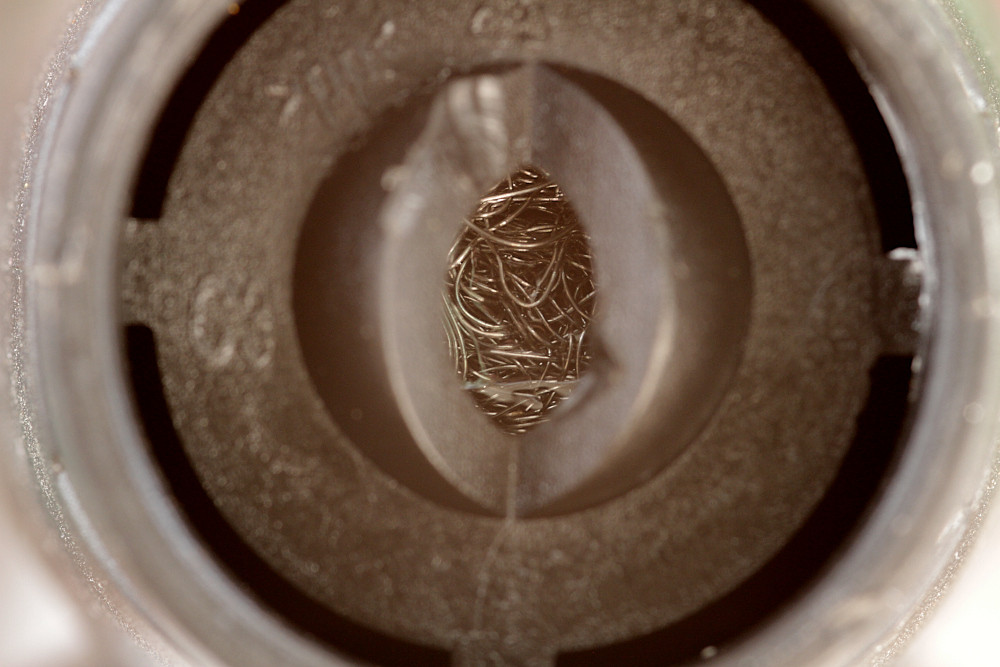
A view of the "sieve" from the front of the nozzle
The recommended method for cleaning these sieves is to place them in a 1:1 mixture of water and vinegar for about an hour, then rinse and let them air dry before reassembling. Instead, I soaked the entire nozzle in a vinegar and water mixture for an hour, then rinsed it by filling the foam cannon's container with water and flushing the sieve with the pressure cleaner for about 30 seconds. This seems to have worked admirably.
Advice: Always flush a foam cannon with water after use.
(updated: 21 December 2025)
Useful links
